| The warm beams of sunlight surround you as you stroll
across campus from your dorm room to the library. Then as you head to a classroom
building, you notice the chirping of birds atop a nearby tree.
These are the memories of many alumni who attended Union University prior to 1975. However when the campus moved from its former location to north Jackson, most campus facilities, with the exception of housing, became conveniently located under one roof. Now Union University is looking to bring the feel of the old, traditional campus to its relatively new home in north Madison County. |
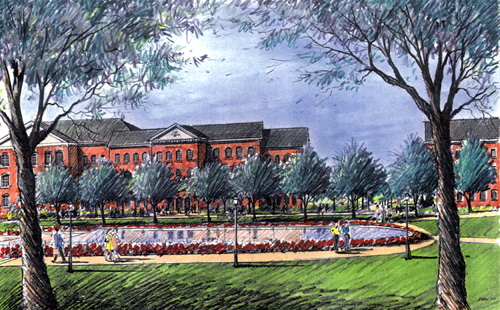 Construction will begin on a fine and performing arts complex during the first phase with the classroom wing scheduled for completion by Fall 2000. Later, the building will house a concert hall and theater facilities. |
| The concept of a campus master plan, which will
dramatically expand and change the appearance of Union University, received
unanimous and enthusiastic approval from the institution's trustees in their
Dec. 5, 1997 meeting.
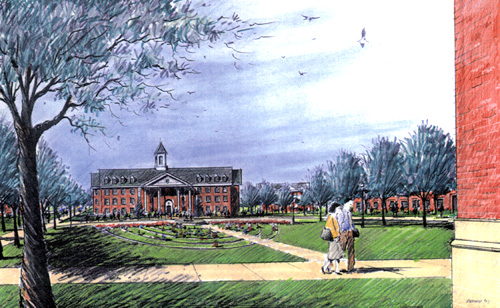
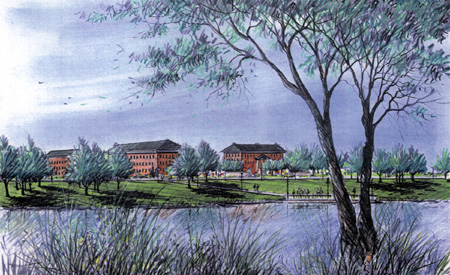
"The master plan for Union projects a stunning, classical campus that will be a crown jewel for Jackson and West Tennessee," asserts university President David S. Dockery. "We are grateful to the Board of Trustees for their vision for Union and their willingness to proceed with this exciting project." The master plan will expand the campus in a westward direction, with the university's primary entrance being at the newly-extended Pleasant Plains Road. The university pre-sently owns more than 150 acres to the west of Walker Road, which forms the current western boundary of the Union campus. That acreage straddles the four-lane parkway that opened in early December and would house virtually all of the projected new facilities. |
|
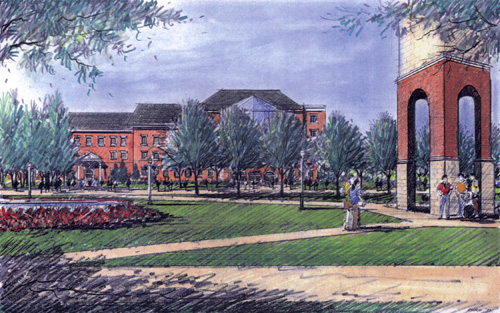
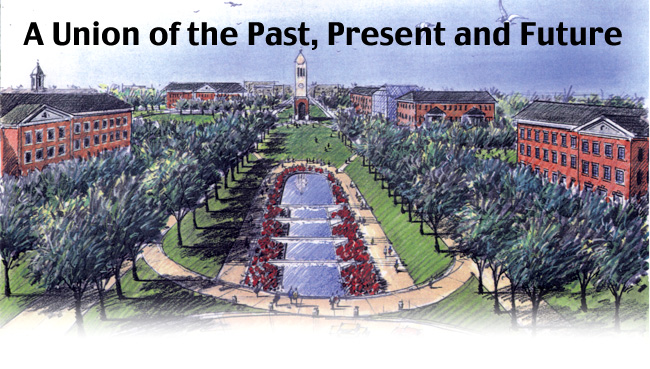
| The new Union entrance would lead to a "great lawn"
(with gardens and water features) running eastward, with new buildings
constructed on either side of this central campus quad. The university's
three existing academic buildings - Penick Academic Complex, Blasingame Academic
Complex, and the Barefoot Student Union Building - would form the eastern
boundary of the campus.
"The campus master plan will provide facilities that reflect Union's commitment to being an excellence-driven institution," explains Dr. Michael Duduit, executive vice president. "Currently Union faces space needs as well as needs related to upgrading classrooms and offices. We want to be sure our physical facilities correspond to our commitment to teaching and that they adequately support our mission as one of the nation's premier Christian Universities." Dockery said architectural and engineering studies will begin immediately and he hopes ground will be broken in Fall 1998 for the first phase of the campus master plan. The plan is divided into three phases of six years each. New facilities in the first phase include a new classroom building for music, communication arts and Christian studies - the first of three elements of a new performing arts complex; a new administration building; a new "apartment village" for married students; an expansion of the university's library, and expanded classroom facilities for nursing, the sciences, the humanities, business, education, and a new program in physical therapy. |
|
| "This is an exciting time to be a student at Union,"
Andrea Aldridge, a sophomore communication arts major, says
enthusiastically. "I've heard stories about what it was like on the old campus
and I'm thrilled about being able to see the beginning of construction as
our campus is transformed to unite the past and the present to insure a very
prosperous future for this great University."
Future phases call for completion of the performing arts center, an athletic-convocation center, a new library building, which will also include new classroom facilities. According to Dockery, the expanded campus would comfortably accommodate a university of some 3,000 students; Union's present enrollment is just over 2,000. Union's master planning process has been underway for almost nine months under the direction of Hastings & Chivetta, a nationally-known consulting firm based in St. Louis. Among the firm's previous clients are Duke, Rhodes, and the University of Tennessee and the University of Chicago. Elements of the educational planning process included a major Space Needs Analysis, performed by the Denver firm of Paulien & Associates, along with a Campus Development Plan shaped by EDAW, Inc., a campus design consultant. "We are pleased with the direction indicated by the proposed master plan, and we are now seeking support from alumni, community and business leaders, and others who care for Union and its future development," Dockery explains. "This is a bold plan which will require the support of the Jackson community as well as many of our friends in West Tennessee and beyond." |
|
| The campus master plan is only one facet of Union's
institutional vision. Planning has begun on developing a technology master
plan and a faculty/staff master plan.
"The technology master plan," explained Dockery, "is a way of strategically positioning Union so that we are as close to the cutting edge as possible." The plan calls for an increase in instructional technology to make Union's classrooms interactive and provide students with up-to-date equipment to assist in their learning and keep them competitive with their counterparts at other institutions. "We dream of having computers for every faculty member and every student," Dockery said. "We're not going to be able to do this overnight and without a plan to identify the steps to move us into the 21st century." The faculty/staff master plan will provide a carefully-developed process for professional development on an ongoing basis for the employees at Union University. Dr. Carla Sanderson, '81, who will assume the office of chief academic officer February 1, 1998, said the plan will "focus on helping us emphasize our strengths and show us some of our weaknesses so that we can improve on them." "The faculty/staff master plan will focus on excellence in teaching, research and service," Dockery added, "under an umbrella of how we, as an institution, can integrate our faith with learning, living and giving." |
Comments and suggestions concerning this site should be forwarded to:
Last updated on February 5, 1998.