
Helping Calm Freshman Fears
by Tracey Pearce King '89
Each fall 1.5 million high school graduates head to college. Yet, even
nine years later only one of every two students will have a bachelor's degree.
Why do some students get lost along the way? Polly Stone Glover, professor,
author and 1961 Union graduate, offers one explanation: students need direction
about the first year of college. 
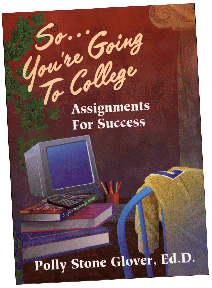
"In spite of everything their parents, guidance counselors or older siblings may have told them about college, a lot of students are shocked when they get there," Polly explains. "Freshmen are faced with living in a new environment, making new friends, studying harder than ever before, and taking responsibility for their life. It's quite an adjustment." As coordinator of the student learning center at the University of Tennessee-Martin, Polly has had the pleasure of watching students develop and reach new levels of academic achievement. Relying on her 30 years of experience teaching college freshmen and interviews with hundreds of others, she has compiled a guide to lead students through the challenges, excitement and choices of their first year of school. So ... You're Going To College, published by CraneWeaver, Inc., covers the four seasons of the freshman year — summer, fall, winter and spring. Before students move into the dorm, Polly encourages them to make some critical decisions about their college days. For example, she reminds students that they will have to learn to deal with stress — inevitably, all their teachers will schedule a test on the same day. By preparing ahead of time, not only for class, but for the stress of college life, students are more likely to adjust and succeed that first year. Another issue Polly suggests students consider before starting school is their response if faculty or other students challenge their beliefs. "The values your parents and community taught you may be challenged in college," Polly reminds readers. "The only values that will last are those you consider and choose for yourself." Polly also believes parents could benefit from reading her book. She says many times parents forget how challenging the first year of college can be and encourages parents to stay connected with their children while they're at school — not only by telephone, but by mail.
Another tip for parents is to help their students find out all they can about their career areas of interest. Polly believes students who have a better grasp about their career choices are much more likely to succeed in their academic pursuits. Parents can help students arrange to spend a couple of days shadowing professionals, or they can encourage students to volunteer in their interest areas. For example, a student interested in broadcasting might volunteer at a local radio or television station. Polly fondly remembers her days as a freshman at Union, and is very thankful to the faculty who helped her throughout her college and graduate careers (she received her master's and doctoral degrees from Vanderbilt University). "Union was such a great experience for me. The faculty were tremendously supportive, and I only hope that I've been able to pass on some of what they taught me to my students over the years." Since the inspiration for So ... You're Going To College has been primarily her students, Polly sees this book as her gift to new students. She sincerely hopes the book has an impact not only on their college days, but also in their life. Polly tells her readers, "The book's power to make a difference lies in your application of the following words of advice. Remember that thousands of students have wrestled with the tasks listed here. They are making a difference in our world — and you will, too." |
 "When my daughter was a freshman, I
called her frequently, but rarely wrote. During Christmas break she commented
about never receiving mail at school, and I realized how important it was
to take time to write. A cheery letter from home can make a student's day."
"When my daughter was a freshman, I
called her frequently, but rarely wrote. During Christmas break she commented
about never receiving mail at school, and I realized how important it was
to take time to write. A cheery letter from home can make a student's day."
