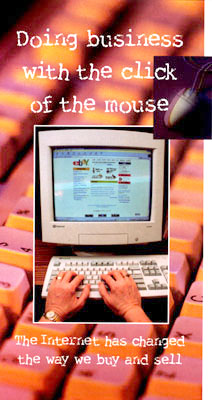
 With a few simple
keystrokes and a click of the mouse, consumers across the world are now buying products
without having to leave the comforts of their own home. With a few simple
keystrokes and a click of the mouse, consumers across the world are now buying products
without having to leave the comforts of their own home. Modern technology has
revolutionized the way we do business. "Decades ago, broadcast technology like radio
and television transformed the business world," says Janice Wood, Assistant Professor
of Communication Arts at Union University. "Now the Internet is making yet another
significant shift by connecting consumers with products in a faster and more interactive
manner."
Darin White, Assistant Professor of Marketing at Union, agrees that the Internet is
having a dramatic effect on the way businesses promote themselves and sell their products
and services. This, in turn, is impacting the global economy. He cites E-Bay, an online
auction site where consumers register to buy, sell and trade personal items, as an
example. In the first year, E-Bay registered more than 300,000 users. Now they have 2.5
million. When the company began selling stock, it opened at $18 per share. Now E-Bay stock
is trading for more than $300. "Wall Street obviously recognizes the potential of the
Internet," White says.
Valerie Howell ('97) was one of thousands of consumers who went Christmas shopping
online for the first time in 1998. "I was looking for a specific CD for my nephew. I
couldn't find it in any of the stores, so I got online and within minutes I had ordered
it," she explains. Howell says she was reluctant to make her first online purchase
because of the potential risks. "I was nervous about providing my credit card number
and wondered if I would even get the CD," she admits. However, the gift arrived and
Howell was more confident about her next purchase.
WHO'S BUYING WHAT ONLINE?
Consumers appear to be moving beyond the perceived risks of shopping online. Cam Tracy
('93), an interactive and new communication technology researcher at Florida State
University, explains that shoppers are avoiding high-ticket items but are more frequently
making less expensive purchases because of issues such as security. He says,
"Individuals tend to go online with specific purchase plans instead of browsing like
one does at the mall." Tracy also explains that consumers usually make their first
online purchase after hearing about a positive experience from a trusted source.
Tracy's study on electronic commerce is beginning to reveal some initial findings about
the demographics of online shoppers. "Catalog shoppers most quickly graduate into
online shopping," he explains. "They are used to not being able to examine the
merchandise and are usually more willing to wait for it to be delivered."
While there was a record number of consumers who utilized the Internet for Christmas
shopping in 1998, retail outlets did not see a decrease in the number of cus-tomers. Brent
Cunningham, Associate Professor of Marketing at Union, says, "There is still and
always will be the need for the shopping experience." Many people use shopping as a
social or recreational activity.
"Is the Internet going to put Wal-Mart out of business?" White asked
jokingly. He answered the rhetorical question simply with a laugh and "no."
While retailers will always have a niche in the market, they now have to serve both
populations —those who want to shop online and those who don't.
A REQUIREMENT FOR BUSINESS
Cunningham explains that technology has leveled the playing field for big and small
companies. While smaller organizations took the lead in using Internet technology, larger
companies were quickly pressured into establishing a web presence. "There's an
expectation now for all credible companies to be on the World Wide Web," Cunningham
says. "Just like in the 1980s, businesses had to have an 800-number because consumers
expected it. Today they must have their own domain name."
 COMPONENTS OF A HOT SITE COMPONENTS OF A HOT SITE
Tracy adds that simply having a domain and web presence isn't enough. Instead companies
who really want to maximize their usage of the Internet must incorporate several
components into their site design:
1. SECURITY ASSURANCE
"People want to know that it's safe to shop at a site," Tracy explains.
Businesses are offering consistent reminders that their site is secure and that customer
order information will be encrypted, transmitted and stored properly.
"Consumers also like the idea of getting some sort of receipt," he adds. Many
companies are accommodating this need with follow-up electronic messages to the consumer's
e-mail box.
White says the issue of security has been overplayed. "Remember 10- 15 years ago
it was unheard of to give your credit card number over the telephone. Now that's very
common," he says. Tracy says security remains an issue in the minds of consumers but
they have greater trust in their credit card companies who will usually back them in case
of credit card fraud.
2. EASY NAVIGATION AND PURCHASING TECHNIQUES
Like any shopping experience, online businesses must be customer-oriented. This happens
most evidently with the design and structure of the site. Easy-to-read menus, site maps
and search mechanisms guide consumers to the products they want. Tracy explains that most
consumer sites are now offering a "shopping basket" feature that encourages
browsing and additional purchases. "Shoppers don't have to keep up with what they
buy," he explains. "They simply add it to their shopping basket, then when they
are finished they can 'check out'."
"Convenience and simplicity are imperative," White says. The Internet gives
the consumer both. Additionally, online shoppers can now do quicker searches to compare
products and prices. "In essence, the Internet has made price even more
important," White adds.
3. VIVID AND INTERACTIVE PRESENTATION
Competing with other media, businesses who use the Internet may capitalize on the web's
ability to provide vivid and interactive presentations of products and services.
"From spinning a piece of clothing 380- degrees to changing colors with a click of
the mouse, online shoppers have something they can't do with a catalog," Tracy says.
Admittedly the vividness of the presentation is limited by the consumer's computer
equipment. Neverthe-less, the individual is usually in control of what they want.
Cunningham says, "Marketing loves the idea of interacting with consumers. The web
makes it possible for businesses to get immediate feedback from customers and potential
customers." This interactivity is most frequently coming in the form of
person-alization, according to Tracy. For example, amazon.com, one of the top web
advertisers, provides consumers with books, music and video products. Using cookies
(information stored on the user's computer), Amazon tracks the customer information and is
able to personalize return visits to its site with a unique greeting and recommendations
based upon previous purchases. Tracy explains this is one way businesses are starting to
develop relationships with consumers.
"This is only the beginning," Cunningham says. "In 20 years we'll see
the Internet take the idea of segmentation to the nth degree. Everything will be
customized. Consumers will see ads specifically tailored to their demographic makeup and
lifestyle."
WHAT'S AHEAD?
Cunningham says that the cost of doing business has not decreased with the emergence of
the Internet. "Companies are still printing catalogs," he explains. "Now
they are being used in conjunction with their web site."
He further comments that there are still "kinks" to work out of the
electronic marketplace. "Companies have to figure out how to do business online
profitably," he says. For examples, amazon.com is just breaking even because they
stock everything. Cunningham predicts that in the future, consumers will be able to order
more directly from the manufacturer.
As the Internet continues to grow at a phenomenal rate, consumers and businesses can
anticipate new doors opening at the click of the mouse. |