 |
 |
|
|
| In Michael Hayes' second semester at Union, he decided to give up a
full-tuition baseball scholarship, so that he could attend chemistry lab on a regular
basis. Like most everything else in his life, Hayes (‘74) came to the unusual
decision after much contemplation. The varsity team's game and practice schedule often
conflicted with lab hours. Charles Baldwin, the O.P. and Evalyn Hammons professor of
chemistry at Union, remembers the day Hayes shared his dilemma and asked for the
professor's advice. Baldwin was prepared to offer Hayes student-worker hours in the
school's aboratories and additional help from the department to make up for the baseball
scholarship. But first he needed to know how seriously Hayes took his education. "I
came to get an education," was Hayes' answer, Baldwin recalls. As Baldwin would soon
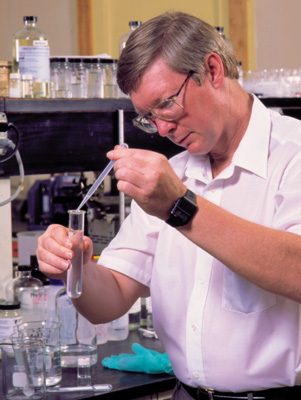
find out, Hayes meant every word of it. Hayes didn't see giving up baseball as a loss but rather a rational conclusion. A self-described "logical guy, " he knew that succeeding in baseball meant making it to the major leagues. And making it to the major leagues took two things: extraordinary skill and extraordinary luck. "The chances that I could make a difference in the science field were much greater," Hayes says. "Even in high school, I saw every test as a sports game -- something to either win or lose," Hayes says. Not accustomed to losing, Hayes chose the option where he was reasonably likely to have the most impact. As CEO of Petroferm, Inc., a research and development company that specializes in making and distributing surface-active agents (surfactants), Hayes has channeled his competitive nature into an excellence- driven work ethic. Placing top priority on performing to the best of his ability, Hayes describes his academic work and his professional career as a game of skill. "I enjoy doing a good job at things," Hayes says. "That's been my No. 1 motivation since college." Graduating from Union in three years, Hayes skill and determination were attractive to Dr. William H. Wade of the University of Texas at Austin. Upon receiving Hayes' application for graduate work, Wade wanted to utilize him for a federally funded research project on tertiary oil refining. Wade had received a $500,000 grant from the federal government and was looking for students to perform the research. Wade called Baldwin. "The day Wade called was such a coincidence. Michael happened to be working in the lab and was able to hear Wade's offer right away," Baldwin recalls. Hayes, a little surprised by the opportunity to bypass a teaching assistantship and jump into the research grant immediately, asked for Baldwin's advice. "I told Mike in no uncertain terms that he should go home right away, pack his bags, say goodbye to his family in Scotts Hill, Tenn., and be in Austin by the end of the week," Baldwin says with a smile. Hayes followed his advice and earned his doctorate from UT-Austin in 1978. Hayes' graduate research in surfactant science and petroleum engineering caught the attention of the oil business and the chemical industry. He says efficient petroleum extraction was the oil business' biggest challenge of the day. At the time, the industry was trying to get more oil out of its wells than was currently possible. Most people don't realize, Hayes explains, how oil is extracted. The familiar pumps that dot the Texas horizon are actually pumping oil out of a rock that has been penetrated. The oil comes out under the pressure of the penetration. In the 1970s only a little over half of the oil in the penetrated rocks was being pumped out. Hayes' work at UT-Austin focused on developing surfactants for detergents designed to "wash out" more oil from the wells.
Underscoring his success, Hayes describes his progress at Petroferm as"normal." In the late 80s, Hayes was chosen to start a subsidiary of Petroferm that would develop and market alternative replacements for ozone dissolving substances. Hayes took on the new role with a vengeance, making the division the biggest in the company within five years and earning the 1993 United States EPA Stratospheric Ozone Protection Award. By 1997 Hayes became CEO of Petroferm. Hayes plays intensely in almost every aspect of his life. Even his Sunday School lessons have footnotes. Hayes expects himself to devote serious study and reflection to his work as a Sunday School teacher at Memorial United Methodist in Fernandina Beach, Fla. "All Christians need a good grounding in the Bible," Hayes says. "I like to help them achieve that by giving extensive commentary on many topics and exposition on the text, mainly in the New Testament." While Hayes admits his job requires him to be on the road about 100 days a year, he insists on pouring significant time and energy into his family life. "There's no job more important than giving your family leadership," Hayes says. He and his wife Connie, a homemaker and active community volunteer, have a son and daughter. Scott, 16, spends most of his free time playing ice hockey on a competitive traveling team. Heather, 14, who also has her dad's love of sports, is a columnist for an online magazine. When asked what his daughter writes about, "She gives personal advice; they call her the Love Doctor," Hayes chuckles. Since the summer of 1998, Petroferm has funded a surfactant research project conducted by Union students. Cathie Scarbrough and Stefan Antoniou, Union students and the lead researchers on the Petroferm project, liked Hayes' under stated demeanor. "When we first met with him to give a progress report, we didn't know what to expect. We were both nervous. But him being relaxed and excited about our project at the same time helped," they say. Baldwin believes Hayes' excellence- driven work ethic, his humble personality and great ability all work together to make him a dynamic leader. After working with Hayes and his colleagues at Petroferm on the Union project, Baldwin says the confidence in Hayes is evident. "His peers know their CEO can outthink any other CEO," Baldwin says. "They've seen when Michael has been underestimated, and they know his enormous ability." |
 Milliken Textiles was the first company to employ
Hayes' work with surfactants. He started as a development chemist at Milliken's chemicals
division. Hayes' recruiter and would-be boss, Connie Butler, left Milliken just before
Hayes started. Soon after, Butler became the first president of Petroferm and offered
Hayes the company's first opening in research and development.
Milliken Textiles was the first company to employ
Hayes' work with surfactants. He started as a development chemist at Milliken's chemicals
division. Hayes' recruiter and would-be boss, Connie Butler, left Milliken just before
Hayes started. Soon after, Butler became the first president of Petroferm and offered
Hayes the company's first opening in research and development.