

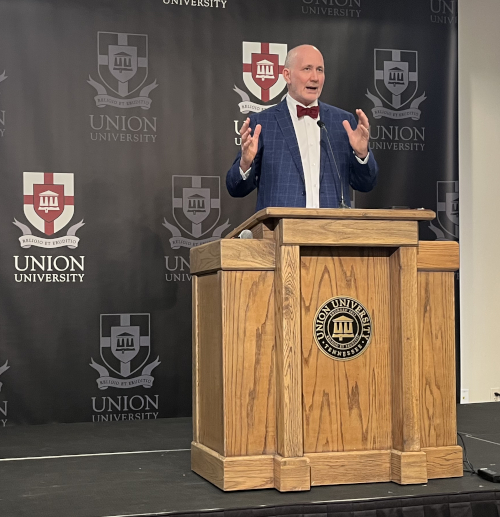
JACKSON, Tenn. — March 24, 2026 — The health and faithfulness of Baptist institutions, Brad Green argued, depends on leaders willing to hold together both their Baptist identity and their broader evangelical convictions, even when institutions drift, battles are lost and the culture pushes back.
Green, professor of theological studies at Union University, made that case March 19 in Union’s 10th annual David and Lanese Dockery Lectures on Baptist Thought and Heritage.
Weaving together personal memoir and intellectual history, Green traced the historical and institutional forces that have shaped Baptist higher education and denominational life in America over the past half-century. He began with his own conversion as a young man in Anchorage, Alaska, recalling the moment he virtually ran to the front of the Baptist church he attended with friends and told the pastor, “I am lost. I want to be saved.”
Among the key figures Green highlighted was theologian Carl F.H. Henry, widely regarded as the dean of 20th-century evangelical theology. Green described Henry as “an institution man, an institution builder” who dreamed of a great evangelical research university, a vision he saw reflected in the efforts of Baylor University President Robert Sloan to integrate Christian conviction across an entire institution.
Green said Sloan wanted Baylor to be a place where students and faculty worked out their convictions under the confession that Jesus is Lord.
Henry’s vision of Christian worldview thinking, Green said, also became foundational to the mission of institutions like Union.
Green reflected on the influence of David S. Dockery, who joined the Southern Baptist Theological Seminary faculty as a conservative voice during the height of the Southern Baptist Convention’s “Battle for the Bible,” a battle Green witnessed firsthand as a student there in the late 1980s.
“My current conviction to affirm the inerrancy of Scripture is due in significant parts to Dockery’s influence,” Green said. “And for that, I’m eternally grateful.”
That influence extended beyond Green’s own formation. When Dockery later came to Union as president in 1996, Green said he brought that same conviction with him.
“Dockery brought with him a robust commitment to Christian worldview thinking,” Green said. “Certainly, Carl Henry’s shadow lies over that conviction.”
These stories, Green argued, offer both inspiration and cautionary lessons for institutions seeking to maintain their Christian identity over time.
“We need courageous leaders who can lovingly, kindly, firmly say, here we stand, and let’s move forward,” he said.
The lectures come as Green prepares to retire from Union this year after 28 years of service, during which he has taught, written extensively and contributed to the broader Christian intellectual community. His most recent book, “What Is Critical Theory? A Concise Christian Analysis,” was published by Crossway.