

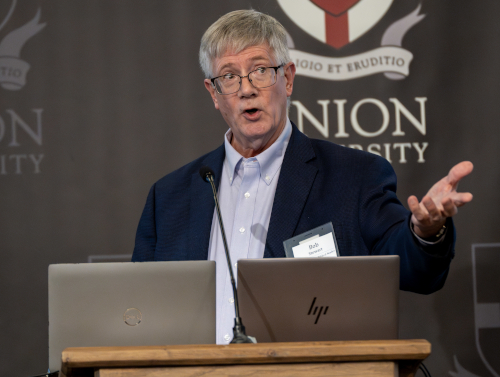
JACKSON, Tenn. — March 26, 2026 — Christians have no reason to worry about the accuracy or preservation of New Testament texts, argued Robert Stewart at the Ryan Center’s 14th annual Bible Conference, held March 20–21 at Union University.
“The New Testament is the most evidenced ancient book of all time,” said Stewart, professor emeritus of philosophy and theology at New Orleans Baptist Theological Seminary and the 2026 plenary speaker.
This year’s conference, entitled “Contending Earnestly: Becoming Faithful Stewards of the Word of God,” centered on apologetics, with sessions related to biblical archaeology, defending Scripture on social media, textual criticism and foundational gospel truths. Presented annually by the Ryan Center for Biblical Studies, the event aims to strengthen personal convictions and equip Christians to defend their faith in a culture that often challenges it.
“As Christians, we’re responsible for the Word that God’s given to us,” said Mike Garrett, director of the Ryan Center. “When you talk to folks about the gospel, some of the first questions that come up are: ‘How do you know? What authority are you appealing to?’ Part of what we’re trying to do this weekend is answer some of that.”
A group of high school students from Carmi, Illinois, attended this year’s conference, engaging in discussions with pastors and college students that broadened the event’s reach to new states and generations.
“There’s such a wide variety of topics and people at this,” said Kimberly Boots, a Master of Business Administration student at Union and a Master of Divinity student at Southern Baptist Theological Seminary who attended the conference. “And everything was spoken in a way that was very practical, easy to understand and accessible for something so complex. It’s wonderful to see the Lord weave all these ideas and people together.”
Fostering that kind of open communication among Christians about new ideas is a key goal of the conference.
“There’s so much fellowship around tables,” Garrett said. “Folks are talking. We have conversations about the talks that have already taken place and the ones coming. That is very important in terms of connecting the material and the people.”
In a plenary session entitled “How Do We Know That We Have What the Biblical Authors Actually Wrote?” Stewart worked to clarify complex material, guiding the attendees through evidence-based manuscript analysis that demonstrated the trustworthiness of biblical texts.
“Does the Holy Spirit work like spellcheck?” Stewart asked. “No, I don’t think that. But I do believe in preservation through the discipline of text criticism. We have Protestants, Catholics, Eastern Orthodox, atheists — so many people check each other.”
Stewart continued by describing different types of manuscript variants that biblical scholars encounter during textual analysis, noting that most were simple spelling or synonym discrepancies. Even more significant differences, he said, can be explained when analyzing the thousands of manuscript copies together.
“We should not shy away from these texts,” Stewart said. “If you want to preach a passage, tell your people about the variants … They’re going to ask questions. If you don't teach them, then they're going to watch a PBS special saying, ‘There are more differences in our manuscripts than there are words in the New Testament.’ Then, they’re … going to think that you're ignorant or you're deceptive. You should always teach.”
For both Stewart and Garrett, transparency in biblical interpretation is essential. With millions of manuscript copies available, as opposed to any other ancient writings, Stewart said he has full confidence in the Bible’s accuracy. Therefore, he articulated that no one should avoid these kinds of conversations and encouraged the conference attendees to apply what they learned in their churches, classrooms and everyday conversations.
“It’s very enticing for folks to sit at home and watch these kinds of things on YouTube in their pajamas,” Garrett said. “But we’re coming out committed to a concentrated study that naturally yields action. We are responsible for the defense of the Word.”