

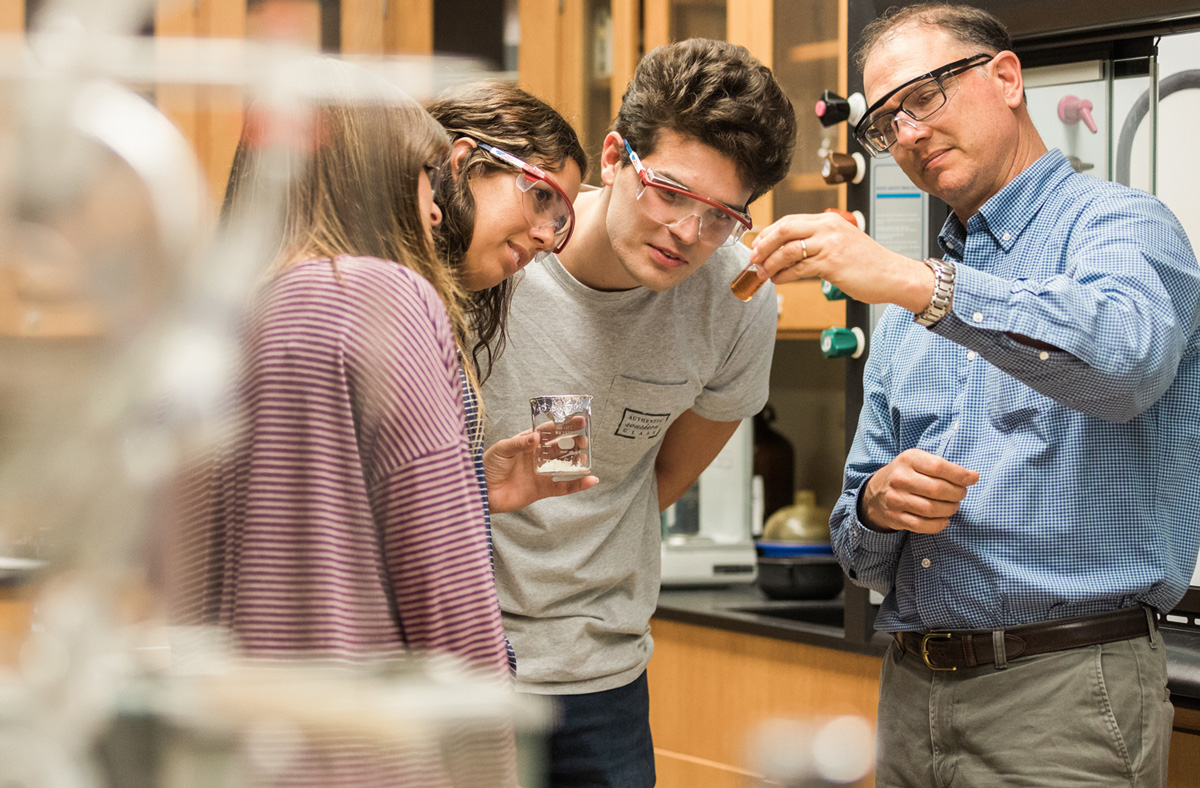
Major in Chemistry
Request Info Apply Now Interested in Medical School?
 ACS Certified
Students who complete the chemistry degree as described below or upon their coursework being approved by the chair of the department, will receive degrees that are certified by the American Chemical Society. Our certified programs offer students a broad-based and rigorous chemistry education that provides them the intellectual, experimental, and communication skills necessary to become successful scientific professionals.
Learn More About ACS Certification
More About American Chemical Society (ACS) Certification
The Chemistry Department at Union University offers a Bachelor of Science in Chemistry or Biochemistry that is certified from the American Chemical Society (ACS). It is important for students and parents to understand why this is significant. These reasons are detailed below, but we should briefly begin with some subtlety regarding ACS certification at other schools.
Many schools have chemistry departments that are certified by the ACS and, thus, can offer a certified chemistry major. However, in comparing schools, one needs to further examine whether or not these schools actually produce graduates who choose the harder curriculum of a certified major or the easier path of an uncertified major. There are schools that have a certified major on their books, but may have trouble getting students to choose the more rigorous and difficult path of a certified major. At least in the students' minds, a chemistry major is a chemistry major is a chemistry major.
Well, not quite. There are many reasons that choosing the harder track of a certified major is beneficial.
- Probably the most important reason for pursuing a certified degree in chemistry is that of rigor. A certified major means that Union's chemistry department has been thoroughly examined by the ACS to ensure that we meet exacting standards. Our faculty, curriculum, and facilities are examined by the accreditors. Everything that is used as part of our major is assessed (classes, textbooks, laboratories, library, instruments, exams, ...). Thus, our graduates know that they've worked hard, learned a tremendous amount of chemistry, and have achieved a degree that is capable of taking them places.
- Another reason that pursuing a certified major in chemistry is important is that of utility. Union's chemistry department enjoys a sterling reputation particularly amongst "local" (Tennessee and contiguous states) graduate and professional schools (chemistry graduate departments and medical, pharmacy, and dental professional schools). However, our graduates have also decided to pursue graduate and professional studies far from Union University where our reputation is not as well known. This is possible, in large part, because of these students earning an ACS certified chemistry degree. Those schools appreciate the qualitative difference between a certified and an uncertified degree.
- Related to what is listed above is the final reason of simply being able to get a job as a practicing chemist. Some of our graduates are not interested in further schooling and desire to graduate and enter the workforce straightaway. Union's chemistry department has been tremendously successful at preparing students to enter the workforce as practicing chemists. Unfortunately, being employable at the bachelor's level of education in one's chosen field of study is uncommon in today's economic and educational environment, but this is not the case in chemistry. Earning a certified major demonstrates to potential employers that the graduate has the experience, abilities, and fortitude to excel as a practicing chemist.
Curriculum for Major
Featured Courses
- CHE 111 - General Chemistry
- CHE 112 - Chemical Equilibrium
- CHE 211 - Analytical Chemistry
- CHE 221 - Analytical Chemistry Laboratory
- CHE 314 - Organic Chemistry I
- CHE 315 - Organic Chemistry II
- CHE 317 - Physical Chemistry I
- CHE 318 - Physical Chemistry II
- CHE 319 - Biochemistry
- CHE 324 - Organic Chemistry Laboratory
- CHE 326 - Organic/Inorganic Synthesis Laboratory
- CHE 327 - Physical Chemistry Laboratory
- CHE 335 - Intermediate Inorganic Chemistry
- CHE 405 - Environmental Chemistry
- CHE 430 - Advanced Inorganic Chemistry
- CHE 435 - Advanced Organic Chemistry
Curriculum for Minor
Featured Courses
- CHE 111 - General Chemistry
- CHE 112 - Chemical Equilibrium
- CHE 211 - Analytical Chemistry
- CHE 221 - Analytical Chemistry Laboratory
- CHE 314 - Organic Chemistry I
- CHE 315 - Organic Chemistry II
- CHE 324 - Organic Chemistry Laboratory
- CHE 326 - Organic/Inorganic Synthesis Laboratory
- CHE 317 - Physical Chemistry I
- CHE 319 - Biochemistry
- CHE 335 - Intermediate Inorganic Chemistry
- CHE 405 - Environmental Chemistry
- CHE 430 - Advanced Inorganic Chemistry