

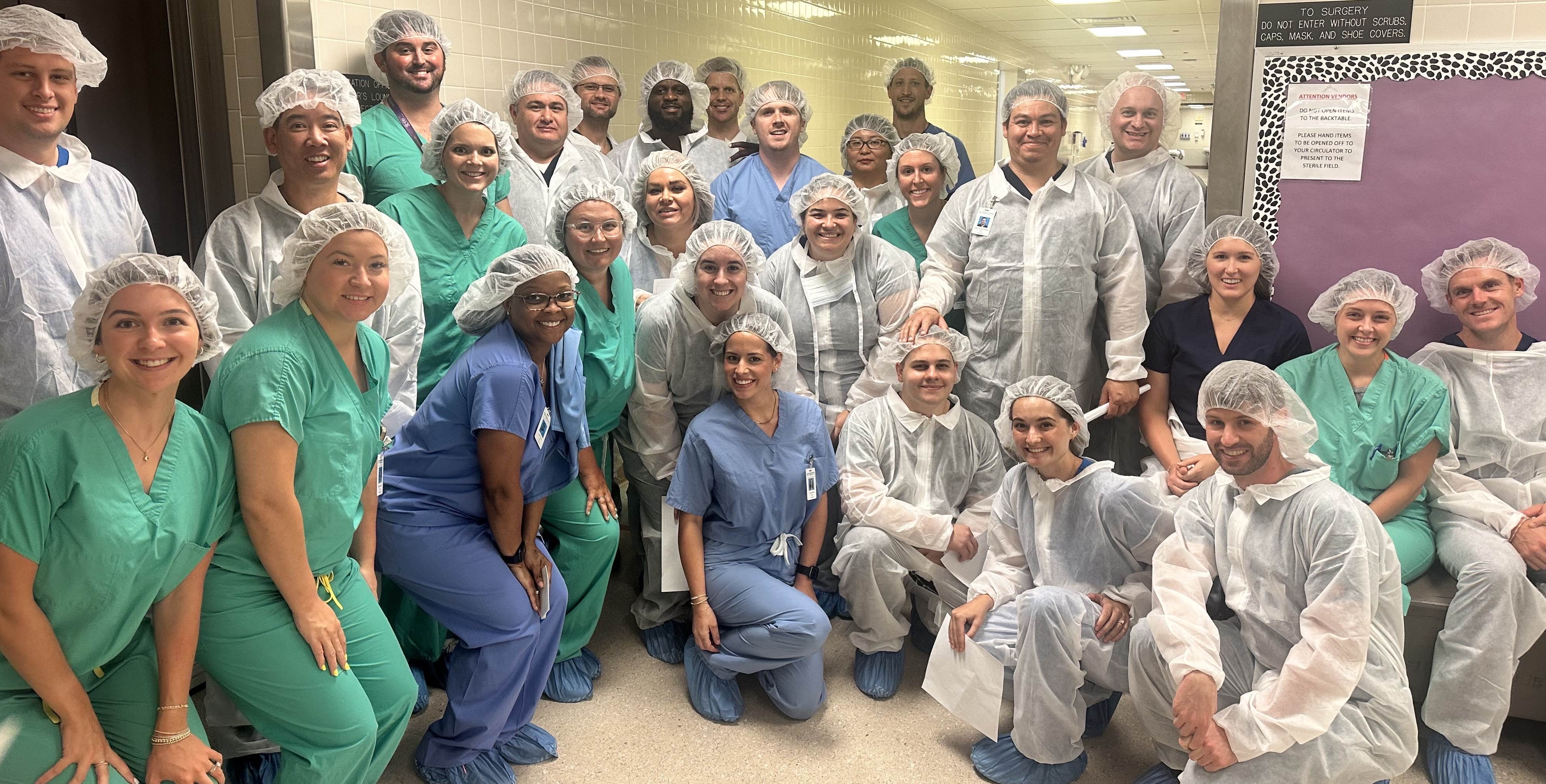
BSN-DNP Nurse Anesthesia Track
As the acuity level of the surgical patients increase and the complexity of the practice continues to demand more of the nurse anesthetist, additional knowledge and skills are being required to serve as a leader in both the operating room suite and within one's practice. To address these growing demands upon the nurse anesthetist, a 36-month BSN-DNP Program is available to enhance your effectiveness as a practitioner and leader in the profession of nurse anesthesia.
Program Offerings and Deadlines
- Available on the Jackson campus only
- Available full-time only
- Application deadlines: The first priority deadline for all application documents is Oct. 1 of each year. The final deadline for all application documents is Jan. 15 of each year. The application cycle for the Fall 2026 cohort opens on Aug. 8, 2025.
2025–2026 Tuition Rates
- $43,275 annually; $14,425 per term - general student fee: $315/term - Estimated Financial Aid Budget
- How To Apply For Financial Assistance
Admission
Admission Criteria
- Current unencumbered RN license. Eligible for multi-state compact license or RN licensure in TN
- Completion of a Bachelor of Science in Nursing from an accredited program.
- Last 60 hours GPA of at least 3.0 on a 4.0 scale.
- Science GPA of 3.0 on 4.0 scale; defined as Anatomy and Physiology 1 and 2, Gen. Chemistry 1 and 2, and Statistics
- CCRN required
- Shadowing hours required (minimum 40 hours)
- Experience as a preceptor and/or charge nurse preferred.
- Leadership within the ICU or place of employment with professional or clinical development projects preferred, such as: policy development, practice change initiatives, evidence-based practice initiatives, instructor in BLS/ACLS/PALS.
- Interview with the Nursing Graduate Admissions Selection Committee
- International students must complete TOEFL with WES evaluations of transcripts
- Statement of past clinical and/or work experiences, scholarly activities, and community service that supports future goals in obtaining a practice doctorate
- One year of critical care experience (ICU experience must be within the last 3 years)
- Students dismissed from a nurse anesthesia or other advanced practice nursing program for academic, clinical or behavioral reasons will not be admitted to Union University's Nurse Anesthesia BSN-DNP track. Students who have been enrolled in another program and withdrew in good standing or are still enrolled in good standing, must have a letter from their director stating that they are in good standing or withdrew when they were in good standing in order to be considered for admission to Union University's Nurse Anesthesia BSN-DNP track.
Admission Contact
 Nursing Admissions:
Amy Joyner
Graduate & Adult Admissions
ajoyner@uu.edu
731-661-5028
 Nurse Anesthesia Office Contact:
Khadija Payne
Coordinator, Nurse Anesthesia Track
kpayne@uu.edu
731-661-5124
Admission Checklist
- Application: All non-traditional and graduate nursing students must complete the NursingCAS application.
Union University requires a Supplemental Application and a non-refundable fee of $50. After submitting your application in NursingCAS, you'll receive an email within 24 hours containing instructions to access your Union Enrollment Status Page. This page will have a link to the Supplemental Application and will provide updates throughout the enrollment process. It's important to submit your NursingCAS application at least 3 - 4 weeks before the deadline to ensure that your application is verified by NursingCAS on time. Unverified or incomplete applications received after the deadline will not be reviewed.
Union University College of Nursing participates in the Nursing Centralized Application Service (NursingCAS). NursingCAS partners with many colleges and schools of nursing to provide an online application to students, collect and process application documents, and verify transcripts on the school's behalf. The school receives information from NursingCAS and is solely responsible for all admission decisions. If you should have questions about your NursingCAS application please feel free to contact them: (Phone: 617-612-2880 Email: nursingcasinfo@nursingcas.org)
- *We strongly recommend checking your personal application page on the NursingCAS application portal to monitor the successful transmission of your transcripts and recommendations. Our admissions staff will also be working with you to ensure application completion.
- Read and sign the Community Values Statement and Standards of Admissions. Both signed pages must be received by the Graduate and Adult Admissions. (part of Supplemental Application Packet)
- Application Fee: The Union University application fee is $50 and is non-refundable. The NursingCAS application fee is $85 and is non-refundable. You have the option to pay online via the NursingCAS website.
- Transcripts: Official transcripts from all post-secondary institutions must be submitted directly through NursingCAS.
Please do not send transcripts for non-traditional nursing programs to Undergraduate Admissions. Transcripts must be received by NursingCAS in a sealed envelope from all previous academic institutions attended. Official transcripts from all post-secondary institutions must be sent to:
- NursingCAS
P.O. Box 9201
Watertown, MA 02471
- NursingCAS
- Letters of Recommendation: Three letters of professional/academic reference specifying the applicant's capabilities for graduate study to include one letter of reference from the current supervisor. Letter of Recommendation forms are a part of the NursingCAS Application.
- Personal Statement: Please provide a statement of professional goals. Topics to be included are:
- Your reason for pursuing the Certified Registered Nurse Anesthesia DNP degree
- How you plan to use the DNP degree to transform the future practice and the profession
- How you have prepared for success in this program
- Please upload these required documents to your NursingCAS application:
- Official current unencumbered Tennessee or Compact State RN Licensure
- Official CCRN Certification valid until school starts in the Fall
- Proof of Shadowing Experience
- Curriculum Vitae/Resume
- Personal Statement of Professional Goals
- Shadowing Hours and Critical Care Experience will both be documented in the Supporting Information section on the NursingCAS application. Specific instructions will be provided on NursingCAS for each.
- Due to U.S. Federal regulations, international students on an F-1 visa are not eligible for this program:
- If you are permanent resident of United States of America, an international application must be completed.
- All international transcripts must be evaluated by an accredited evaluating agency found at the National Association of Credential Evaluation Services' website: naces.org
- Applications that are incomplete, unverified, and/or not submitted by the application deadline will not be considered for admission.
Admission FAQ
Q: Can I apply with a single state license (non-compact)?
A: Yes, you can apply with the RN license you currently have. If your license expires within the application cycle or during consideration, please make sure to send your updated license to ajoyner@uu.edu. Your license must also be unencumbered.
Q: What is included in the Science GPA? How do you handle retakes?
A: We calculate A&P I and II, Chemistry I and II, and Statistics as our Science GPA. If there are any of these that have been retaken, we will take the most recent grade for the calculation.
Q: Where can I locate the supplemental application and where can I submit my shadow log?
A: Your Union Supplemental Application will be emailed to you within 24 hours of submission of your NursingCAS application. You will open the link sent to your email and that is where the supplemental application will be housed. You will need to remember your username and password created, but if not, please reach out to Amy Joyner for a password reset or if you do not receive the supplemental after the 24-hour window. This portal is where the rest of your admissions journey will take place, so it is very important to keep up with it. Your shadow log with a minimum of 40 shadowing hours will be uploaded to the supplemental application. The minimum of 40 shadowing hours must be completed at the time of application, otherwise the application will not be complete.
Q: My transcripts were submitted to NursingCAS, but they are not marked off into the portal. What should I do?
A: NursingCAS tells the portal what transcripts were submitted but does not tell the portal when they are delivered. The Red Xs in the portal are marked manually by GAA when an applicant is verified on NursingCAS. All transcripts regardless of a degree earned or not MUST be submitted in NursingCAS to be delivered to NursingCAS. Transcripts that are delivered to the university will not be accepted and will not make an application verified. If your application is not verified or your transcripts have not been delivered after at least 14 days, please contact NursingCAS.
Q: Who can I use for my references?
A: You must have a minimum of 3 references but can add up to 4 maximum. One of the 3 minimum MUST be from a supervisor. This cannot be from a Charge Nurse. It must be an RN supervisor, Director, Manager, etc. The others can be from colleagues, other supervisors, or instructors. If you have a unique situation that needs clarification, please contact Amy Joyner.
Q: What qualifies for Critical Care experience and when do I need to have it by?
A: You must obtain a minimum of 1 year ICU experience (excluding orientation time) within the last 3 years — must be in a unit that has high acuity patients (e.g. ventilators, invasive monitoring, vasoactive drips). These units usually have a 1:2 nurse to patient ratio at the most. Critical Care experience needs to be in the United States. If you do not have it by the time you apply, you must have your 1 year minimum by matriculation into the program.
Examples that may be included but are not limited to:
- Surgical Intensive Care
- Cardiothoracic Intensive care
- Coronary Intensive Care
- Medical Intensive Care
- Pediatric Intensive Care
- Neonatal Intensive Care
- Flight Nurse
Experience that does not count: Emergency Room, Cath lab, Stepdown, and Rapid Response Team.
Q: I have international transcripts and/or an international student. How should I proceed?
A: All international transcripts will need to be evaluated by WES and then delivered to the NursingCAS application. If you are a non-US Citizen or a student on an F-1 visa, you do not qualify for this program. Applicants from a country where the native language is not English may be required to show proof of English proficiency with scores no lower than a 105 on the Duolingo English Proficiency Test. If you are a Permanent Resident of the United States, you will need to submit your Permanent Residency card upon application via email to Amy Joyner. There is no additional application for applicants in this situation.
Q: I have a degree or pre-requisites that have a P/F (Pass/Fail). How does that affect my application?
A:
- The NAT program does not accept/transfer credits from courses taken on a pass/fail basis. All courses completed from other institutions prior to admission must adhere to the numerical GPA scale to meet the admission requirements.
- Applicants that have a prior degree from an institution that has a grading system of Pass/Fail will be reviewed on an individual basis by the program chair.
Q: I have been enrolled in a previous Nurse Anesthesia program and/or advanced practice nursing program. Can I still apply?
A: Students dismissed from a nurse anesthesia or other advanced practice nursing program for academic, clinical or behavioral reasons will not be admitted to Union University's Nurse Anesthesia BSN-DNP track. Students who have been enrolled in another program and withdrew in good standing or are still enrolled in good standing, must have a letter from their director stating that they are in good standing or withdrew when they were in good standing in order to be considered for admission to Union University's Nurse Anesthesia BSN-DNP track.
Q: Is the CCRN required?
A: Yes. It is required at the time of application and must stay up to date through the application and consideration process through matriculation into the program.
Q: What does Rolling Admissions mean for the NAT Program?
A: The NAT program has 2 deadlines; a Priority deadline of October 1st and a final deadline of January 15th. Our NAT department will host in-person interviews here at our Jackson, Tennessee campus a few weeks after each deadline. The application runs every year from August to January for the purpose of starting in the following August. After the priority deadline, as many seats in the cohort will be filled (30 total each year prior to 2026; beginning in 2026, the number may increase.) from the interviewees selected. However, after the final deadline, the remaining seats will be filled with interviewees that are eligible starting after the priority deadline. If an applicant interviewed during priority and were denied, the applicant would be out of that cycle completely. If a priority seat holder were to drop before the final deadline, a priority wait-lister would take their place versus giving the final deadline an extra seat. Any application after the final deadline will not be considered for the cohort applied for, and it will not carry over into the next year. The applicant will need to reapply for the next cohort in the following August.
Q: What qualifies my application to be processed?
A: Your NursingCAS application MUST be verified which includes submitting all documents, references, transcripts, and fees as well as completing your Union supplemental application with attached, completed shadow form, and fee. Without both of those components completed by the final deadline, applications are considered incomplete. Please do not send transcripts to the university during the application process. Transcripts will need to be sent to NursingCAS through the NursingCAS application for applications to verify correctly.
Q: What can I do to improve my competitiveness?
A: In addition to meeting the admission criteria, the following is a list of suggestions to improve an applicant's competitiveness for the Nurse Anesthesia Program:
- Repeat any Science course in which you have a grade less than B, especially A&P, Chemistry, Microbiology, Pathophysiology, and Statistics.
- If an applicant does not need to repeat any courses, it is suggested that applicants take Advanced Pathophysiology or graduate-level Statistics to demonstrate the ability to complete graduate-level work.
- It is recommended that applicants could also take undergraduate Inorganic and Organic Chemistry courses and should achieve a grade of B or better.
- Although the GRE is not required, it can only help an applicant demonstrate their ability for Graduate level work.
- Obtain CCRN certification (required by program admissions) and sub-specialty certification: Cardiac Surgery (CSC), CMC, etc.
- Obtain a minimum of 1 year ICU experience (excluding orientation time) — must be in a unit that has high acuity patients (e.g. ventilators, invasive monitoring, vasoactive drips). These units usually have a 1:2 nurse to patient ratio at the most. Critical Care experience needs to be in the United States.
- A minimum of 40 hours of job shadowing is required. It is recommended to shadow in multiple different practice environments, including CRNA independent practice sites.
- Become more involved in current unit (ex: Charge Nurse (preferred), Unit Council member, other leadership responsibilities that includes professional or clinical development projects such as policy development, practice change initiatives, evidence-based practice initiatives, instructor in BLS/ACLS/PALS)
Q: How is my last 60 hours GPA Calculated?
A: Calculation of GPA for the last 60 hours will occur as follows:
- The grades used to calculate the 60 hours GPA will be the most recent, and exactly 60 hours will be included in the calculation. If a partial semester must be utilized, the course with the highest grade will be chosen, and the number of hours needed will be multiplied by the grade. For example, if 2 hours are needed to complete the 60, and the applicant has a 3 hour course in which they earned an A, 8 points will be added (2 x 4 = 8).
- If an applicant re-took a course, the higher grade will be used in the calculation; the lower grade will not count in the calculation at all.
- Plus and minus grades will be considered as standard A, B, C, etc. For example, an A+ and an A- will both be assigned 4 quality points per credit hour.
Curriculum Model
BSN-DNP Curriculum Model
| Fall I (Aug. – Dec.) | ||
|---|---|---|
| NUR 720 | Faith and Science* | 3 |
| NUR 515 | Advanced Nursing Statistics for the Health Sciences* | 3 |
| NUR 544 | Advanced Health Assessment | 3 |
| NUR 519 | Professional Aspects | 3 |
| BIO 505 | Applied Anatomy & Physiology I (1st 8 Weeks) | 3 |
| BIO 507 | Applied Anatomy & Physiology II (2nd 8 Weeks) | 3 |
| 18 | ||
| Spring I (Jan. – May) | ||
| NUR 533 | Advanced Nursing Research and Evidence Based Practice* | 3 |
| NUR 715 | Technological Transformations of Healthcare* | 3 |
| NUR 609 | Basics of Anesthesia | 4 |
| NUR 622 | Advanced Pharmacology | 3 |
| BIO 509 | Applied Human Gross Anatomy | 4 |
| 17 | ||
| Summer I (June – Aug.) | ||
| NUR 532 | Advanced Pharmacology II | 3 |
| BIO 500 | Advanced Pathophysiology | 3 |
| NUR 534 | Advanced Principles in Anesthesia | 3 |
| NUR 559 | Role Development and Collaborative Strategies in Advanced Nursing Practice* | 2 |
| NUR 524 | Anesthesia Techniques | 3 |
| 14 | ||
| Fall II (Aug. – Dec.) | ||
| NUR 710 | Methods for Evidence Based Practice* | 3 |
| NUR 730 | Epidemiology* | 3 |
| NUR 613 | Cardiovascular Pulmonary Anesthesia: Perspectives of Anesthetic Care | 3 |
| NUR 614 | Neurosurgical Anesthesia: Perspectives of Anesthetic Care | 2 |
| NUR 554 | Clinical Practicum I | 1 |
| 12 | ||
| Spring II (Jan. – May) | ||
| NUR 793 | DNP Project Development* | 3 |
| NUR 725 | Healthcare Policy and Economics* | 3 |
| NUR 611 | Obstetrical Anesthesia: Perspectives of Anesthetic Care | 2 |
| NUR 612 | Pediatric Anesthesia: Perspectives of Anesthetic Care | 2 |
| NUR 574 | Clinical Practicum II | 2 |
| 12 | ||
| Summer II (June – Aug.) | ||
| NUR 735 | Fellowship I | 2 |
| NUR 705 | Organizational Leadership and Management* | 3 |
| NUR 745 | Leadership and Teaching Practice Strategies* | 3 |
| NUR 691 | Nurse Anesthesia Clinical Residency | 1 |
| 9 | ||
| Fall III (Aug. – Dec.) | ||
| NUR 791 | DNP Project Implementation* | 3 |
| NUR 738 | Fellowship II | 3 |
| NUR 691 | Nurse Anesthesia Clinical Residency | 1 |
| 7 | ||
| Spring III (Jan. – May) | ||
| NUR 794 | DNP Project Completion* | 3 |
| NUR 739 | Fellowship III | 3 |
| NUR 691 | Nurse Anesthesia Clinical Residency | 1 |
| 7 | ||
| Summer III (June – Aug.) | ||
| NUR 728 | Transitions to DNP Practice | 3 |
| NUR 691 | Nurse Anesthesia Clinical Residency | 1 |
| 4 | ||
| * Represents Online Courses | ||
| Total Credit Hours | 100 | |
| Total Clinical Hours | 2860 | |
| Total Months | 36 | |