

 Union to launch civil and computer engineering concentrations
November 20, 2025 - Union University’s Department of Engineering will add concentrations in civil engineering and computer engineering beginning in the fall 2026 semester. The Bachelor of Science in Engineering currently offers concentrations in mechanical engineering and electrical engineering. “Our vision for the department has always been to add more concentrations,” said Jeannette Russ, chair of the engineering department. “We just had to wait until the time was right, and we feel like that time is right now.” Civil engineering encompasses t... READ MORE
 Chapman headlines Union’s 27th annual Scholarship Banquet
November 5, 2025 - A concert by Christian recording artist Steven Curtis Chapman and a celebration of the 10-year anniversary of Union University’s EDGE program highlighted the 27th annual Union Scholarship Banquet Nov. 5 at the Carl Perkins Civic Center. FirstBank and Elite Contractors were the lead sponsors for this year’s Scholarship Banquet. “The Scholarship Banquet is always a key event at Union every year we celebrate the generosity of donors and invest in the dreams and future success of our students,” said Catherine Kwasigroh, Union’s vice pre... READ MORE
 Conn named Alumnus of the Year as part of Union’s annual Homecoming week
October 29, 2025 - Union University’s 2025 Homecoming celebration included the recognition of 16 alumni and friends of the university for outstanding achievements in their respective fields and the presentation of Union’s Homecoming Court, among other activities. “As we celebrated Homecoming, we saw the impact Union alumni and students have not only on campus but in communities near and far,” said Catherine Kwasigroh, Union’s vice president for institutional advancement. “Their commitment to service and excellence reflects the values at the heart of Union’s... READ MORE
 Union serves local residents during 23rd annual Campus and Community Day
October 23, 2025 - For Union University junior Rebekah Ruth Basie, serving at Jackson’s Birth Choice pregnancy medical clinic on Tuesday was about more than simply lending a helping hand to a local nonprofit organization. “As a believer, if the Lord cares about life, I should care about life,” Basie said. “And not in name only.” Basie, a sociology major from Pine Mountain, Georgia, was one of more than 700 Union University students and employees who participated in the 23rd annual Campus and Community: A Day of Remembrance and Service. Each year, Unio... READ MORE
 Janney challenges Union community to rethink Civil War history
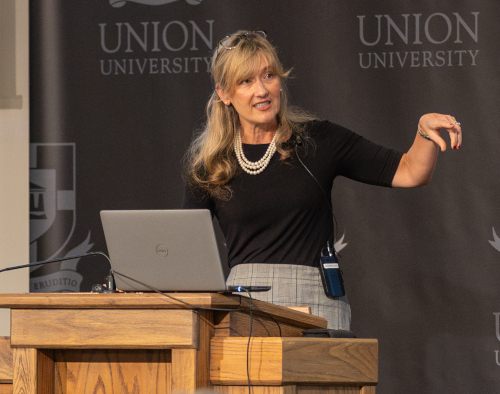
October 8, 2025 - Think of Appomattox as a starting place rather than an ending point, Caroline Janney told a group of Union University students and Jackson community members Oct. 6 in the G.M. Savage Memorial Chapel. “Indeed, there are as many stories that begin in Appomattox as there were men there: Union and Confederate, black and white,” said Janney, the John L. Nau III Professor of the American Civil War at the University of Virginia. As the 28th annual Carls-Schwerdfeger Lecture Series speaker, Janney gave two addresses related to the American ... READ MORE
 Union to serve Jackson at 23rd annual Campus and Community Day
October 7, 2025 - Hundreds of Union University students, faculty and staff members will participate in 30 projects in Jackson and West Tennessee Oct. 21 as part of Union’s 23rd annual “Campus and Community: A Day of Remembrance and Service.” The event is an opportunity for Union to show its appreciation to the community for its assistance after tornadoes hit the campus in 2002, 2003 and 2008. Union cancels most classes on this day each year to allow the university community to participate in projects at such places as local schools, churches, nursing homes... READ MORE
 Union offering free Wellness Center access to Tennessee Baptist pastors
September 30, 2025 - Union University is extending a new benefit to Tennessee Baptist pastors, offering them free membership at the university’s Wellness Center, with discounted rates for their wives. Ray Van Neste, Union’s vice president for university ministries and dean for the School of Theology and Missions, said the benefit connects with Tennessee Baptist Mission Board’s initiatives emphasizing pastoral wellness. “Our Tennessee Baptist pastors are men who are faithful shepherds, and we are thankful for them,” Van Neste said. “At Union, we want to... READ MORE
 Remember Me Walk for homicide loss survivors set for Sept. 29
September 26, 2025 - Union University will host the 17th annual Remember Me Walk for survivors of homicide loss Sept. 29. Each year, families come together on Union’s campus to honor and celebrate the lives of their loved ones lost to homicide. Survivors are invited to a meal at 5:30 p.m. (no registration required) in the Carl Grant Events Center, followed by a brief program. After the program, participants will take a short walk around the Great Lawn in memory of their loved ones. The Union School of Social Work’s Center for Just and Caring Commu... READ MORE
 Clifton encourages local pastors to be faithful with what God has given
September 18, 2025 - God is doing tremendous things in normative-sized churches, Mark Clifton said to a crowd of local pastors and their wives at Union’s annual Pastors and Wives Appreciation Banquet Sept. 16. “I am convinced, beyond a shadow of a doubt, that we really have gotten off track,” said Clifton, the North American Mission Board’s executive director of replant, revitalization and rural strategies. “We think that we've got to grow larger numerically to be faithful. The truth of the matter is that we just have to be faithful with the ones he’s given u... READ MORE
 Union art gallery hosts exhibit on German Expressionism
September 17, 2025 - An exhibit curated by Sandra Bowden that features the work of German Expressionists is on display in the Union University art gallery through Nov. 13. “Was God Dead? Biblical Imagination in German Expressionist Prints” explores the question of why biblical imagery saturates Expressionist literature and the visual arts. The exhibit includes nearly 50 works from such artists as Max Beckmann, Lovis Corinth, Kathë Kollwitz, Otto Dix, Christian Rohlfs, Schmidt-Rottloff, Vassily Kandinsky, and Edvard Munch, among others. Bowden is a renow... READ MORE