Skip to Content

Department of Psychology

Understand people. Serve them well.

The deeper you understand human behavior, the better equipped you are to care for people — and at Union, that pursuit happens within a Christian framework that sees every person as an image-bearer worthy of genuine understanding and genuine care.

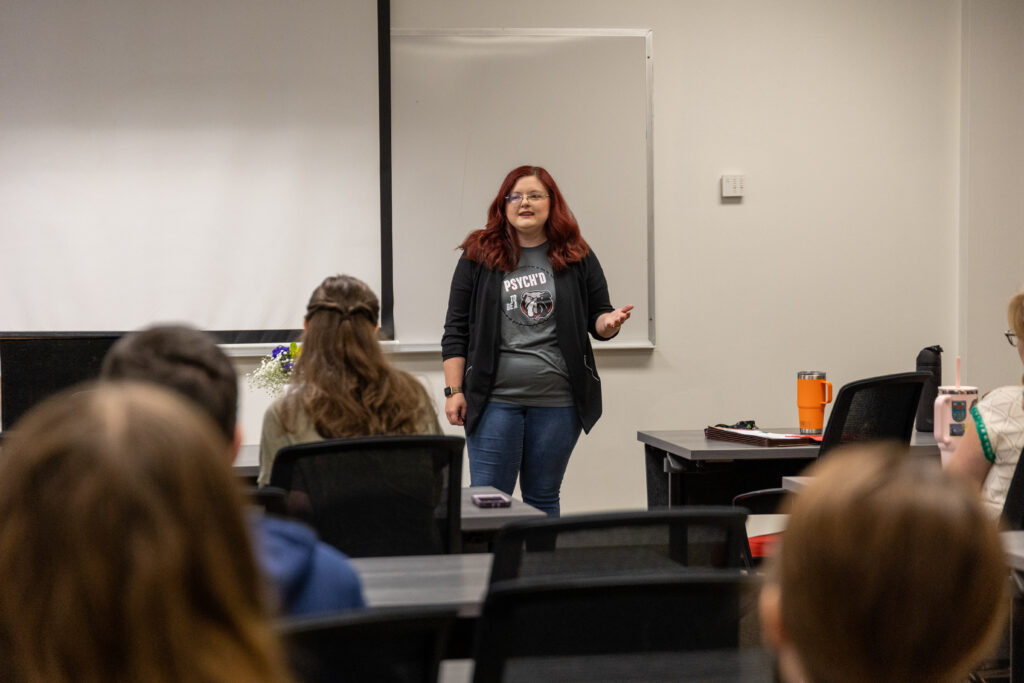
A woman with red hair stands at the front of a Psychology Department classroom, speaking to seated students. She wears jeans, a t-shirt, and a jacket. A phone and tumbler rest on a desk nearby. A whiteboard is behind her.
A woman stands at a podium speaking to a small audience in a classroom. There are desks, chairs, a flower arrangement, and a whiteboard in the background. The audience listens attentively.

Ethos

We develop the whole student so you can serve the whole person.

Psychology at Union is pursued with the conviction that every person whose behavior and mental processes you study is an image-bearer of God — made with extraordinary complexity and inherent dignity. Our department is committed to developing the whole student, challenging and supporting you in building a genuine understanding of human relations and individual adjustment that you can apply both personally and professionally. Whether you are headed to graduate study, counseling, social work, human resources, or ministry, you will leave equipped with the scientific foundation, the people skills, and the Christian formation to serve the people in your care well.

Undergraduate Programs

In Person

Psychology

The Psychology program at Union University equips students to understand human nature, flourishing, and psychopathology through a distinctly Christ-centered perspective. Students engage psychological theory and evidence-based practice critically, building the preparation needed for graduate study, clinical training, and a wide range of careers in human services, business, education, and ministry.

Department of Psychology Faculty

Union's psychology faculty are scholars and people of faith who bring both scientific expertise and genuine care for students into every classroom. With small class sizes and a strong undergraduate research program, students work closely with professors who invest personally in their academic development and vocational discernment — preparing them for graduate programs and careers where understanding people well makes all the difference.

Research

Our Psych Research Group is led by Dr. Mollie Carter and Dr. Luke Walden. Our group conducts research in various areas of Psychology, such as social media, self-efficacy, personal epistemology, and psychometrics.

The mission of this group is two-fold: (1) To produce high-quality, publishable research that advances the global understanding of psychology in some capacity. (2) To provide our students with hands-on experience in research design, data collection, and statistical analysis to prepare them for graduate-level success.

About Our Research

While the research group is a collective whole, Dr. Carter and Dr. Walden have distinct research agenda that warrants two subgroups.

Dr. Carter’s Group

Dr. Carter primarily studies issues that impact emerging adults with the goal of helping college students think rightly about themselves so they can endure hardship and flourish. She developed a curriculum on Christian self-compassion that counselors are using with their clients. Her research group is currently completing a series of articles on their social media research. They are looking ahead toward research on parental expectations and achievement motivation in hopes of developing a Christian model of achievement motivation that pushes back against the world’s tendency to equate achievement with self-worth.

Dr. Walden’s Group

Dr. Walden‘s primary research agenda focuses on personal epistemology – the views and beliefs people hold regarding what is considered true knowledge. His dissertation focused on creating and validating a questionnaire to measure personal epistemology in college students.

Current Group Members

  • T.J. Hjelte
  • Dona Kaci
  • Tina Chen
  • Eliana Isom
  • Addison Altizer
  • Eliana Butler
  • Kate Rutherford

Research Group Alumni

  • Chloe Perkins (’24)
  • Ethan Hager (’25)
  • Makenna Tiffany (’25)
  • Rivers Abshere (’25)
  • Alex Reeder (’26)
  • Sydnie Arnolds (’26)
  • Lily Grace Wamble (’26)
  • Sydney Coffman (’26)
  • Eliana Isom (’26)
  • Abby Farmer (’26)

Research Dissemination

The research produced by this group is disseminated in number of ways, both poster and presentation formats:

Featured and Recent Publications

From Traits to Texts: Personality Predictors of Reading Flow

Authors: Sydney Coffman, Eliana Isom, Lily Grace Wamble, Ethan Hager, Alex Reeder, & Dr. Walden

Publication Date: June 2026

Abstract:
While research has explored reading flow and empathy as independent constructs, few studies have simultaneously examined the associations between these variables within a single model. This study investigated the pathways between personality, empathy, and aspects of reading flow state in a sample of undergraduate students in the midsouth United States (n = 197). We investigated whether openness and extraversion relate to reading flow and the degree to which empathy functions as a mediator in this process. Results indicated that openness significantly predicted reading flow, whereas extraversion served as a significant negative predictor. The mediation hypothesis was not supported, empathy failed to significantly predict reading flow despite its associations with personality subscales. Results revealed that reading flow impacts reading behavior, significantly predicting increased genre variety and annual reading volume. These findings suggest that the flow state in reading is primarily a function of openness rather than social-emotional processing associated with empathy.

Read More

A Pilot Study of Self-Compassion and Social Media Problems: Associations, Moderations, and Speculations

Authors: Dr. Carter, Tina Chen, & Allison Bryan

Publication Date: December 2025

Abstract: Researchers reject the idea that social media use causes anxiety and depression, instead reporting that cognitive and behavioral variables of social media self-control failure, fear of missing out, and social media social comparison contribute to anxiety and depression. While prohibiting, delaying, or fasting from social media are suggested by popular writers as answers to these problems, prohibiting social media is known to be ineffective at preventing these cognitive social media problems once a person begins using social media. Moving forward, counselors should prepare themselves to use the therapeutic tools they currently have or develop new tools for treating clients whose problems are related to social media. We sought to determine if social media self-control failure, fear of missing out, and social media social comparison were associated with deficiencies in self-compassion. Our pilot study (n = 61) confirmed that the problematic social media outcomes share considerable variance with deficiencies in self-compassion with moderation models found. Thus, self-compassion interventions may be useful for treating social media self-control failure, fear of missing out, and social media social comparison, but future research will need to explore the efficacy of these interventions.

Read More

Featured and Recent Presentations

Amplification of Emotion on Social Media / Doomscrolling (poster)

Authors: Dr. Carter, Tina Chen, Dona Kaci, & T.J. Hjelte

Publication Date/Location: October 2025 at Tennessee Psychological Association Annual Convention

Beyond the physical: A moderated regression analysis of exercise motivation and frequency, religiosity, and depression (poster)

Authors: Abby Farmer

Publication Date/Location: March 2026 at Union University Scholarship Symposium

Underneath the surface: Latent personalities and their impact on mental health (poster)

Authors: Eliana Butler & Tina Chen

Publication Date/Location: March 2026 at Union University Scholarship Symposium

No middle ground? Exploring the dichotomy of religion and science through Rasch analysis (poster)

Authors: Addison Altizer & Dona Kaci

Publication Date/Location: March 2026 at Union University Scholarship Symposium

The relationship between personal epistemology, belief in science, religiosity & spirituality (Conference presentation)

Authors: Addison Altizer, T.J. Hjelte, & Kate Rutherford

Publication Date/Location: April 2026 at Mid-South Psychology Conference (Martin, TN)

Latent profile analysis of personality and mental health scores (Conference presentation)

Authors: Dona Kaci, Tina Chen, & Eliana Butler

Publication Date/Location: April 2026 at Mid-South Psychology Conference (Martin, TN)

How To Get Involved

The primary purpose of the research group is to expose undergraduate psychology students at Union University to research experiences and opportunities they cannot find elsewhere.

To join the group, we ask you to first complete PSY 213 (Intro to Psychology, at Union or equivalent at another university) and then to fill out the application below. The applications are reviewed on a rolling basis, but we strongly encourage interested students to complete the application before the start of a semester.

Apply Today | Request More Information

All who are eligible to join are welcome to apply. Even if you do not have strong research skills (e.g., literature review, data analysis, presentation) we can find something for you to do to help bolster your CV. The primary objective of this lab is to obtain research experience, not necessarily to become a master of research methods.

If you would like to join the group, you will also need to complete the Institutional Review Board (IRB) tutorial. The IRB exists to ensure that human subjects research is conducted ethically and that participants are protected. Follow the link below to complete the tutorial (and associated quiz).

Union’s IRB

Connect with Us

Follow us on social media to stay up to date on the latest news and events from the Department of Psychology department at Union University.