
Union University student uses 3D printing to bring Tractor Supply facility to life
- October 21, 2026
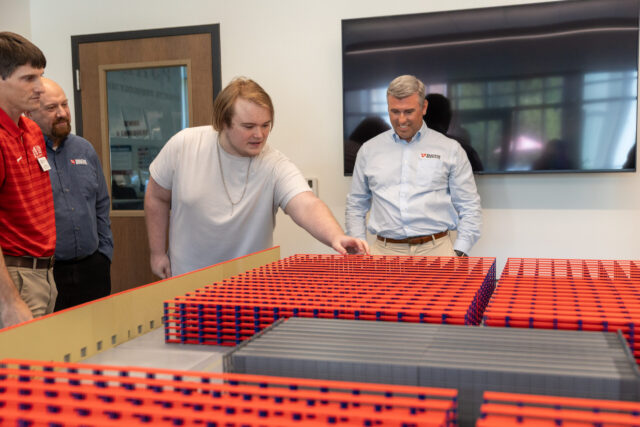
What started as an opportunity to build his engineering portfolio turned into a major project for Union University sophomore Tyson Endicott, who spent months designing and 3D-printing a model of Tractor Supply’s newest distribution center in Nampa, Idaho.
On Oct. 19, representatives from H&M Company, Inc. and Tractor Supply Co. gathered in The Ethos Forum to mark the completion the project.
Halfway through his freshman year Endicott, a Jackson native, started looking for projects to help build his portfolio. At the same time, Jackson-based H&M was searching for someone to create a 3D model of a new distribution center for its longtime customer, Tractor Supply.
 James Kirkland, senior vice president of construction operations at H&M, connected Tractor Supply with Union when he realized Union had the capabilities of 3D printing and design.
Having just completed a 3D drawing class, Endicott soon heard from professor Georg Pingen about a potential opportunity that would bring his classroom experience into the real world. By mid-March, he had been trained and onboarded as a student assistant in The HUB, Union’s collaborative design and innovation space, and began working on the Tractor Supply model
Designing and 3D-printing Tractor Supply’s distribution center
Over the next several months and throughout the summer, Endicott worked to refine his designs and create a model that would look suitable in a professional setting.
“The beginning was definitely the hardest part,” Endicott said. “Even now, I’m still learning how to improve the design process in my projects.”
Outfitted with a new automated storage and retrieval system, the building marks a new generation of distribution centers for the nation’s largest rural lifestyle retailer.
For Endicott, working through the design of the automated system was his favorite part.
“I had to make a lot of creative decisions about how to simplify the conveyor system designs while keeping them coherent. I really enjoyed working through those challenges,” he said.
With a desire to showcase the building and provide an overview of the automated system, Tractor Supply will use this tabletop model to give a bit of perspective to what can be an overwhelming space, at roughly 860,000 square feet.
“We only look to do more automation in the future,” said Brian Smith, vice president of automation and engineering. “As we give tours, as we have different vendors come in, this [3D model] will be the focal point in this building.”
With an expected productivity gain of 50 percent, Tractor Supply envisions using this facility as a model for future expansion.
“It provides efficiency for the operation and allows us to get more product in a smaller footprint,” said Scott Wheatley, Tractor Supply’s director of logistics engineering.
Pingen helped facilitate the project and acted as the go-between for Endicott and H&M.
“It’s been an amazing opportunity for Tyson and for us to do some things that we don’t usually get to work on,” Pingen said.
Building connections between Union engineering and industry
The project reflects the engineering program’s efforts to build partnerships with local industries and give students practical experience while providing businesses access to Union’s resources.
During the presentation, Tractor Supply made a donation to Union in appreciation of the work completed on the model which will soon be shipped to its new home in Idaho. 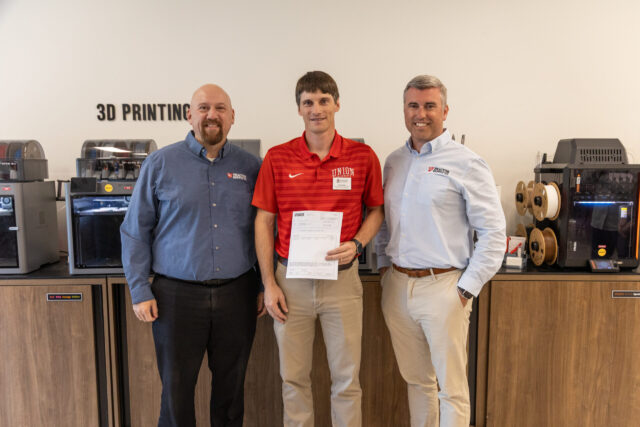
Brad Anderson, engineering project manager at H&M, managed the team responsible for designing the facility. He said the opportunity to collaborate with Union on the 3D model was “an added bonus.”
“I’m glad that we have such a good university here in Jackson that has the capabilities to do this,” Anderson said. He added that opportunities like this enhance students’ educational experiences and make Union’s engineering program more valuable.
For Endicott, the project provided practical experience beyond the classroom. Throughout the project, he gained skills in interpreting Revit models, adapting designs for 3D printing and managing a long-term project.
“I’ve also become more comfortable working through problems that don’t have an obvious solution,” Endicott said.
Continue Reading
A Life Well Engineered: Van’s Next Great Adventure
A Life Well Engineered: Van’s Next Great Adventure

Dear Freshmen: The Reflections of a Senior
Dear Freshmen: The Reflections of a Senior

3D Print of the New Academic Building
3D Print of the New Academic Building