

Center Receives National Award
UUSOP Center for Interprofessional Education/Population Health and Rural Medicine Receives National Award
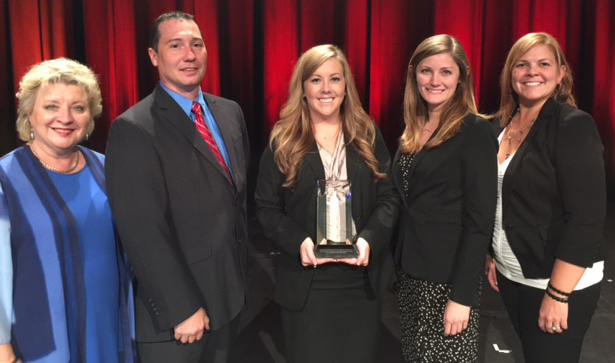
Representatives of the UUSOP pictured from left to right: Dean Mitchell, Dr. King, Dr. Todd (2015), Kelsey Turcotte (2017), and Dr. Rogers (2012)
The Union University School of Pharmacy (UUSOP) was selected to receive the American Association of Colleges of Pharmacy (AACP) 2015 Student Community Engaged Service Award, recognizing their work within the West Tennessee community. The award winning project is an interprofessional effort entitled "Project Population Health and Rural Medicine (PHaRM)" which is housed within the Center for Interprofessional Education/Population Health and Rural Medicine (IPE/PHaRM). The purpose of Project PHaRM is to advance the UUSOP's ability to better care for the underserved population of West Tennessee, and it does so in several important ways. First, it serves as a model for effectively creating and utilizing interdisciplinary collaborations between pharmacists, social workers, and nurses in a community pharmacy setting. Second, it serves as a rubric for demonstrating how community pharmacy can play an integral role in addressing Healthy People 2020 goals and objectives, and demonstrates the positive impact the profession can have on improving the health of communities. Third, a focus of Project PHaRM is to improve the medication consumption behavior of patients' prescribed cholesterol, hypertension, and/or diabetes medications. Finally, Project PHaRM allows community pharmacy to play an integral role in addressing the serious issues associated with inadequate functional health literacy (FHL) and its effect on the medication consumption process. It is believed the activities associated with Project PHaRM will equip UUSOP students and faculty with the knowledge and skills needed to effectively address the health promotion and disease prevention needs of underserved populations and reduce the negative health impact these disease states have within our community.
Allison Todd, Pharm.D.(Class of 2015), served as the student team leader on Project PHaRM led by faculty mentor Sean King, M.S., Ph.D., associate professor of pharmaceutical sciences and director of the Center for IPE/PHaRM, and Erica Rogers, Pharm.D. (Class of 2012), research associate within the Center for IPE/PHaRM.
In addition to the Center for IPE/PHaRM students and faculty, many area pharmacies, Ginny Schwindt, MSW, of Union's School of Social Work and Melissa Walls, RN, and Angela Webb, RN, of West Tennessee Healthcare's Disease Management within the Lift Wellness Center also played integral roles in the project. Thanks to help from these individuals, access to health services for the underserved within our community has been greatly expanded. This team also allowed us to remain true to the core values of Union University of being excellence-driven, Christ-centered, people-focused and future-directed.
The Student Community Engaged Service Award was presented on July 14, 2015, during the AACP Annual Meeting in National Harbor, MD. The awards consists of a crystal sculpture for the Pharmacy School, certificates for the faculty advisor and students, and a $5,000 team prize to be used exclusively to support program expansion of recognized or new community engaged service projects.
About the award: The Student Community Engaged Service Awards recognize student-led community engagement projects conducted either as a component of the curriculum or as an extra-curricular program. The most outstanding student-directed program at a college or school of pharmacy should be submitted. Service learning is included in pharmacy college/school curricula and identified as a needed curriculum component by the Accreditation Council for Pharmacy Education. Because it is a structured learning experience, often experiential in nature, it lends itself well to a wide range of community-connected projects and outcomes evaluation.
The program is intended to encourage student pharmacists and faculty to design and build programs of community-engaged service learning, delivering consumer education about medication use, expanding access to affordable medications and improving public health. An important corollary benefit of these programs is better educating pharmacy college/school faculty and students on the contemporary issues of consumerism and access to affordable healthcare and medication therapy.