

Nurse Anesthesia Track
The Doctor of Nursing Practice with specialization in Nurse Anesthesia from Union University prepares you with the skills and knowledge for full-scope anesthesia practice including anesthetic administration in all specialties, regional anesthesia, point-of-care ultrasound, and pain management. The nurse anesthesia program addresses the critical leadership skills needed to translate evidence-based care into practice, change systems of care and measure outcomes of groups of patients, populations, and communities.
Graduates are prepared to practice in a wide array of clinical settings, translate research and other evidence into clinical practice, and assume leadership roles in anesthesia groups and healthcare systems. Graduates from our program have a 100% job placement rate after graduation and practice across the country.
Track Highlights
Quick Facts
- Instruction: Front-Loaded Hybrid Program (on-campus courses in Jackson, TN with online courses for core DNP curriculum).
- Admission Term: Fall Only
- Admissions Deadline: Rolling Admissions with priority deadlines of October 1 and January 15 of each year.
Accreditation
The Council on Accreditation of Nurse Anesthesia Educational Programs, 222 S. Prospect Ave., Park Ridge, IL 60068-4001, Phone: 847-655-1162, coacrna.org. We are fully accredited through 2032.
Program Highlights
- 36-Month, 97 Credit Program
- Variety of clinical experiences including Level 1 Trauma Centers and Rural All-CRNA Groups
- Dedicated rotations in Cardiac Anesthesia, Obstetrics, Pediatrics, Trauma, and Regional Anesthesia.
- Strong focus on sciences including gross anatomy with over 60 hours of whole cadaveric dissection
- 8th Plastination Lab in country
- Dynamic and ongoing interaction between students and our dedicated faculty of experienced nurse anesthetists
- Outstanding faculty and clinical preceptors who are committed to each student’s education
Study with Faculty Who Know the Field
Instructors take both your professional competence and personal formation seriously, preparing you to practice and lead at the highest level.

Mary Crouse
Assistant Chair of Nurse Anesthesia and Assistant Professor of Nurse Anesthesia; Director of Plastination Lab
Mary Crouse
Assistant Chair of Nurse Anesthesia and Assistant Professor of Nurse Anesthesia; Director of Plastination Lab

Morgan Grones
Assistant Professor of Nurse Anesthesia
Morgan Grones
Assistant Professor of Nurse Anesthesia

BethAnn Jones
Assistant Professor of Nurse Anesthesia
BethAnn Jones
Assistant Professor of Nurse Anesthesia

Molly Wright
Chair of Nurse Anesthesia Program & Professor of Nurse Anesthesia
Molly Wright
Chair of Nurse Anesthesia Program & Professor of Nurse Anesthesia
Accreditation
Union University Nurse Anesthesia Track is fully accredited by the Council on Accreditation of Nurse Anesthesia Educational Programs (COA). The Doctor of Nursing Practice (DNP) program received a 10-year reaccreditation in 2022 and is fully accredited through 2032. The program will undergo its formal review process in the Spring of 2032.
Graduates are eligible to take the National Certification Exam (NCE) administered by the National Board of Certification and Recertification for Nurse Anesthetists (NBCRNA). Graduates who pass the NCE are designated as a Certified Registered Nurse Anesthetist (CRNA).
Academic programs covered by COA Accreditation Status:
- Nurse Anesthesia Entry Level BSN-DNP Degree
- Nurse Anesthesia DNP Completion Degree
- Post-Masters DNP
- CRNA to DNP (For CRNAs with a BSN)
Council on Accreditation of Nurse Anesthesia Educational Programs (COA)
10275 W. Higgins Rd., Suite 906
Rosemont, IL 60018-5603
Main Number: 224-275-9130
Fax: 847-728-8128
Email: [email protected]
Achievement Rates
Track Statistics
- 37 Clinical sites
- 93% NCE Pass Rate
Attrition Rates
- Class of 2027 — 0%
- Class of 2028 — 7%
- Class of 2029 — 0%
NCE Pass Rates
| Cohort Year | Union NCE Pass Rate with Subsequent Attempts | Union First-Time Pass Rate | National Average Pass Rate | Employment within 6 months of graduation |
|---|---|---|---|---|
| Class of 2025 | 96.4% | 93% | 83.2% | 100% |
| Class of 2026 unofficial | 92.9% | 82% | Unknown at this time | 100% |
Admissions
Admission Contacts
Nursing Admissions:
Amy Joyner
Graduate & Adult Admissions
[email protected]
731-661-5028
Nurse Anesthesia Office Contact:
Khadija Payne
Coordinator, Nurse Anesthesia Track
[email protected]
731-661-5124
Admission Criteria
- Current unencumbered RN license. Eligible for multi-state compact license or RN licensure in TN
- Completion of a Bachelor of Science in Nursing from an accredited program.
- Last 60 hours GPA of at least 3.0 on a 4.0 scale.
- Science GPA of 3.0 on 4.0 scale; defined as Anatomy and Physiology 1 and 2, Gen. Chemistry 1 and 2, and Statistics
- CCRN required
- Shadowing hours required (minimum 40 hours)
- Experience as a preceptor required.
- Experience as a charge nurse preferred.
- Leadership within the ICU or place of employment with professional or clinical development projects preferred, such as: policy development, practice change initiatives, evidence-based practice initiatives, instructor in BLS/ACLS/PALS.
- Interview with the Nursing Graduate Admissions Selection Committee
- Applicants from a country where the native language is not English may be required to show proof of English proficiency with scores no lower than 80 on the TOEFL iBT (computerized). In addition, students must provide WES evaluations of transcripts or another NACES (National Association of Credential Evaluation Services) approved agency found at the National Association of Credential Evaluation Services’ website.
- Statement of past clinical and/or work experiences, scholarly activities, and community service that supports future goals in obtaining a practice doctorate
- One year of critical care experience (ICU experience must be within the last 3 years)
- Students dismissed from a nurse anesthesia or other advanced practice nursing program for academic, clinical or behavioral reasons will not be admitted to Union University’s Nurse Anesthesia BSN-DNP track. Students who have been enrolled in another program and withdrew in good standing or are still enrolled in good standing, must have a letter from their director stating that they are in good standing or withdrew when they were in good standing in order to be considered for admission to Union University’s Nurse Anesthesia BSN-DNP track.
Admission Checklist
- Nursing CAS Application: Union University College of Nursing participates in the Nursing Centralized Application Service (NursingCAS). NursingCAS partners with many colleges and schools of nursing to provide an online application to students, collect and process application documents, and verify transcripts on the school’s behalf. The school receives information from NursingCAS and is solely responsible for all admission decisions. All non-traditional and graduate nursing students must complete the NursingCAS application. It’s important to submit your NursingCAS application at least 3-4 weeks before the deadline to ensure that your application is verified by NursingCAS on time. Unverified or incomplete applications received after the deadline will not be reviewed. If you have questions about your NursingCAS application, please feel free to contact them: (Phone: 617-612-2880 Email:[email protected]). The NursingCAS application fee is $90 and is non-refundable. This fee is not collected by the university.
The following components will be uploaded onto the NursingCAS application:- Transcripts: Official transcripts from all post-secondary institutions including those from institutions in which applicants did not graduate but did take courses must be submitted directly through NursingCAS. Please do not send transcripts for non-traditional nursing programs to the University. Transcripts must be received by NursingCAS either digitally or in a sealed envelope from all previous academic institutions attended. All international transcripts must be evaluated by an accredited evaluating agency found at the National Association of Credential Evaluation Services’ website: naces.org
Official transcripts from all post-secondary institutions must be sent to:
NursingCAS
P.O. Box 9201
Watertown, MA 02471 - Letters of Recommendation: Three letters of professional/academic reference specifying the applicant’s capabilities for graduate study to include one letter of reference from the current supervisor. Supervisor recommendations must be from someone in a managerial or supervisor role. Charge Nurse references will not be considered as such. Letter of Recommendation forms are a part of the NursingCAS Application in which references will receive a link to upload their letter of recommendation as well as fill out their questionnaire to the email provided.
- Please upload these required documents to your NursingCAS application:
- Official copy of current unencumbered RN license in state of residence
- Official copy of CCRN Certification valid until school starts in the Fall
- Curriculum Vitae/Resume
- Personal Statement of Professional Goals
Topics to be included are:- Your reason for pursuing the Certified Registered Nurse Anesthesia DNP degree
- How you plan to use the DNP degree to transform the future practice and the profession
- How you have prepared for success in this program
*We strongly recommend checking your personal application page on the NursingCAS application portal to monitor the successful transmission of your transcripts and recommendations. Our admissions staff will also be working with you to ensure application completion.
- Transcripts: Official transcripts from all post-secondary institutions including those from institutions in which applicants did not graduate but did take courses must be submitted directly through NursingCAS. Please do not send transcripts for non-traditional nursing programs to the University. Transcripts must be received by NursingCAS either digitally or in a sealed envelope from all previous academic institutions attended. All international transcripts must be evaluated by an accredited evaluating agency found at the National Association of Credential Evaluation Services’ website: naces.org
- Union University Supplemental Application:
After submitting your application to NursingCAS, you’ll receive an email within 24 hours containing instructions to access your Union Enrollment Status Page. This page will have a link to the Supplemental Application and will provide updates throughout the enrollment process. If you do not receive that link within 24 hours of submission, please contact your Graduate and Adult Admissions Counselor for a password reset link to be sent to your email. Within this supplemental, the following will be submitted:- Proof of Shadowing Experience (minimum of 40 hours is required at time of application)
- Read and sign the Community Values Statement and Standards of Admissions
- Application Fee: The Union University application fee is $50 and is non-refundable. You are able to pay the application fee with a credit card at the end of the application.
- Due to U.S. Federal regulations, international students on an F-1 visa are not eligible for this program:
- Applicants from a country where the native language is not English may be required to show proof of English proficiency with scores no lower than 80 on the TOEFL iBT (computerized). In addition, students must provide WES evaluations of transcripts or another NACES (National Association of Credential Evaluation Services) approved agency found at the National Association of Credential Evaluation Services’ website.
- Applications that are incomplete, unverified, and/or not submitted by the application deadline will not be considered for admission.
Admissions FAQ
Q: Can I apply with a single state license (non-compact)?
A: Yes, you can apply with the RN license you currently have. If your license expires within the application cycle or during consideration, please make sure to send your updated license to [email protected]. Your license must also be unencumbered.
Q: What is included in the Science GPA? How do you handle retakes?
A: We calculate A&P I and II, Chemistry I and II, and Statistics as our Science GPA. If there are any of these that have been retaken, we will take the most recent grade for the calculation.
Q: Where can I locate the supplemental application and where can I submit my shadow log?
A: Your Union Supplemental Application will be emailed to you within 24 hours of submission of your NursingCAS application. You will open the link sent to your email and that is where the supplemental application will be housed. You will need to remember your username and password created, but if not, please reach out to Amy Joyner for a password reset or if you do not receive the supplemental after the 24-hour window. This portal is where the rest of your admissions journey will take place, so it is very important to keep up with it. Your shadow log with a minimum of 40 shadowing hours will be uploaded to the supplemental application. The minimum of 40 shadowing hours must be completed at the time of application, otherwise the application will not be complete.
Q: My transcripts were submitted to NursingCAS, but they are not marked off into the portal. What should I do?
A: NursingCAS tells the portal what transcripts were submitted but does not tell the portal when they are delivered. The Red Xs in the portal are marked manually by GAA when an applicant is verified on NursingCAS. All transcripts regardless of a degree earned or not MUST be submitted in NursingCAS to be delivered to NursingCAS. Transcripts that are delivered to the university will not be accepted and will not make an application verified. If your application is not verified or your transcripts have not been delivered after at least 14 days, please contact NursingCAS.
Q: Who can I use for my references?
A: You must have a minimum of 3 references but can add up to 4 maximum. One of the 3 minimum MUST be from a supervisor. This cannot be from a Charge Nurse. It must be an RN supervisor, Director, Manager, etc. The others can be from colleagues, other supervisors, or instructors. If you have a unique situation that needs clarification, please contact Amy Joyner.
Q: What qualifies for Critical Care experience and when do I need to have it by?
A: You must obtain a minimum of 1 year ICU experience (excluding orientation time) within the last 3 years — must be in a unit that has high acuity patients (e.g. ventilators, invasive monitoring, vasoactive drips). These units usually have a 1:2 nurse to patient ratio at the most. Critical Care experience needs to be in the United States. If you do not have it by the time you apply, you must have your 1 year minimum by matriculation into the program.
Examples that may be included but are not limited to:
- Surgical Intensive Care
- Cardiothoracic Intensive care
- Coronary Intensive Care
- Medical Intensive Care
- Pediatric Intensive Care
- Neonatal Intensive Care
- Flight Nurse
Experience that does not count: Emergency Room, Cath lab, Stepdown, and Rapid Response Team.
Q: I have international transcripts and/or an international student. How should I proceed?
A: All international transcripts will need to be evaluated by WES and then delivered to the NursingCAS application. If you are a non-US Citizen or a student on an F-1 visa, you do not qualify for this program. Applicants from a country where the native language is not English may be required to show proof of English proficiency with scores no lower than a 105 on the Duolingo English Proficiency Test. If you are a Permanent Resident of the United States, you will need to submit your Permanent Residency card upon application via email to Amy Joyner. There is no additional application for applicants in this situation.
Q: I have a degree or pre-requisites that have a P/F (Pass/Fail). How does that affect my application?
A:
- The NAT program does not accept/transfer credits from courses taken on a pass/fail basis. All courses completed from other institutions prior to admission must adhere to the numerical GPA scale to meet the admission requirements.
- Applicants that have a prior degree from an institution that has a grading system of Pass/Fail will be reviewed on an individual basis by the program chair.
Q: I have been enrolled in a previous Nurse Anesthesia program and/or advanced practice nursing program. Can I still apply?
A: Students dismissed from a nurse anesthesia or other advanced practice nursing program for academic, clinical or behavioral reasons will not be admitted to Union University’s Nurse Anesthesia BSN-DNP track. Students who have been enrolled in another program and withdrew in good standing or are still enrolled in good standing, must have a letter from their director stating that they are in good standing or withdrew when they were in good standing in order to be considered for admission to Union University’s Nurse Anesthesia BSN-DNP track.
Q: Is the CCRN required?
A: Yes. It is required at the time of application and must stay up to date through the application and consideration process through matriculation into the program.
Q: What does Rolling Admissions mean for the NAT Program?
A: The NAT program has 2 deadlines; a Priority deadline of October 1st and a final deadline of January 15th. Our NAT department will host in-person interviews here at our Jackson, Tennessee campus a few weeks after each deadline. The application runs every year from August to January for the purpose of starting in the following August. After the priority deadline, as many seats in the cohort will be filled (30 total each year prior to 2026; beginning in 2026, the number may increase.) from the interviewees selected. However, after the final deadline, the remaining seats will be filled with interviewees that are eligible starting after the priority deadline. If an applicant interviewed during priority and were denied, the applicant would be out of that cycle completely. If a priority seat holder were to drop before the final deadline, a priority wait-lister would take their place versus giving the final deadline an extra seat. Any application after the final deadline will not be considered for the cohort applied for, and it will not carry over into the next year. The applicant will need to reapply for the next cohort in the following August.
Q: What qualifies my application to be processed?
A: Your NursingCAS application MUST be verified which includes submitting all documents, references, transcripts, and fees as well as completing your Union supplemental application with attached, completed shadow form, and fee. Without both of those components completed by the final deadline, applications are considered incomplete. Please do not send transcripts to the university during the application process. Transcripts will need to be sent to NursingCAS through the NursingCAS application for applications to verify correctly.
Q: What can I do to improve my competitiveness?
A: In addition to meeting the admission criteria, the following is a list of suggestions to improve an applicant’s competitiveness for the Nurse Anesthesia Program:
- Repeat any Science course in which you have a grade less than B, especially A&P, Chemistry, Microbiology, Pathophysiology, and Statistics.
- If an applicant does not need to repeat any courses, it is suggested that applicants take Advanced Pathophysiology or graduate-level Statistics to demonstrate the ability to complete graduate-level work.
- It is recommended that applicants could also take undergraduate Inorganic and Organic Chemistry courses and should achieve a grade of B or better.
- Although the GRE is not required, it can only help an applicant demonstrate their ability for Graduate level work.
- Obtain CCRN certification (required by program admissions) and sub-specialty certification: Cardiac Surgery (CSC), CMC, etc.
- Obtain a minimum of 1 year ICU experience (excluding orientation time) — must be in a unit that has high acuity patients (e.g. ventilators, invasive monitoring, vasoactive drips). These units usually have a 1:2 nurse to patient ratio at the most. Critical Care experience needs to be in the United States.
- A minimum of 40 hours of job shadowing is required. It is recommended to shadow in multiple different practice environments, including CRNA independent practice sites.
- Become more involved in current unit (ex: Charge Nurse (preferred), Unit Council member, other leadership responsibilities that includes professional or clinical development projects such as policy development, practice change initiatives, evidence-based practice initiatives, instructor in BLS/ACLS/PALS)
Q: How is my last 60 hours GPA Calculated?
A: Calculation of GPA for the last 60 hours will occur as follows:
- The grades used to calculate the 60 hours GPA will be the most recent, and exactly 60 hours will be included in the calculation. If a partial semester must be utilized, the course with the highest grade will be chosen, and the number of hours needed will be multiplied by the grade. For example, if 2 hours are needed to complete the 60, and the applicant has a 3 hour course in which they earned an A, 8 points will be added (2 x 4 = 8).
- If an applicant re-took a course, the higher grade will be used in the calculation; the lower grade will not count in the calculation at all.
- Plus and minus grades will be considered as standard A, B, C, etc. For example, an A+ and an A- will both be assigned 4 quality points per credit hour.
Frequently Asked Questions
What is accepted as a Critical Care Experience?
Critical Care Experience — Critical care experience must be obtained in a critical care area within the United States, its territories or a U.S. military hospital outside of the United States. During this experience, the registered professional nurse has developed critical decision making and psychomotor skills, competency in patient assessment, and the ability to use and interpret advanced monitoring techniques.
A critical care area is defined as one where, on a routine basis, the registered professional nurse manages one or more of the following:
- invasive hemodynamic monitors (such as pulmonary artery catheter, CVP, arterial)
- cardiac assist devices
- mechanical ventilation
- vasoactive infusions
Examples of critical care units may include but are not limited to:
- Surgical Intensive Care
- Cardiothoracic Intensive care
- Coronary Intensive Care
- Medical Intensive Care
- Pediatric Intensive Care
- Neonatal Intensive Care
- Flight Nurse
Those who have experiences in other areas may be considered provided they can demonstrate competence with managing unstable patients, invasive monitoring, ventilators, and critical care pharmacology.
What is the course schedule for an SRNA each year?
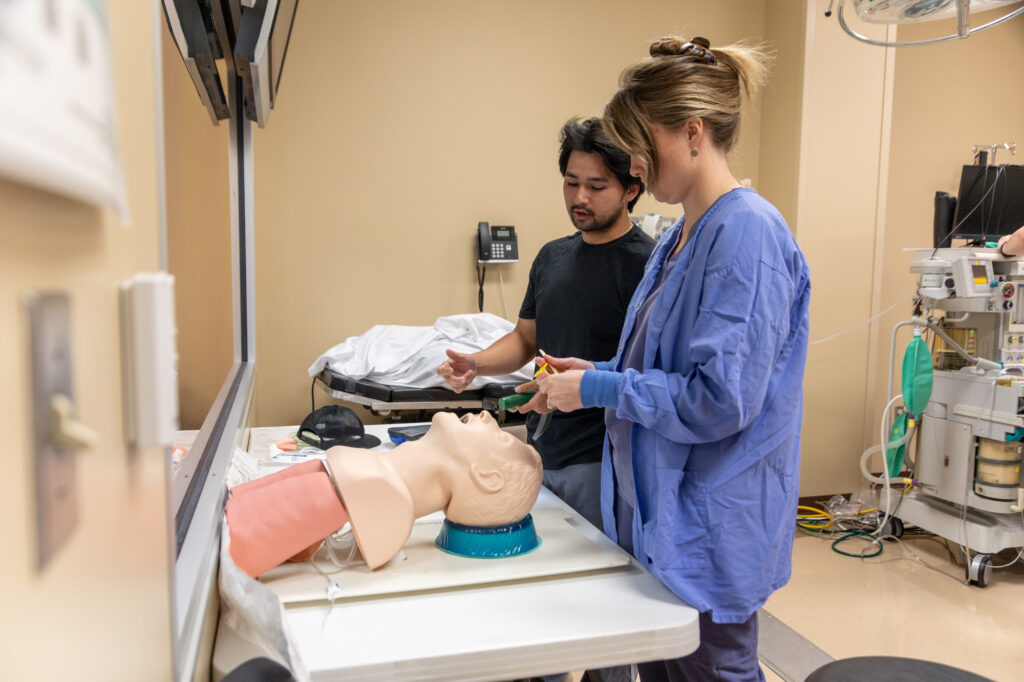
- During Year 1, students are on campus in Jackson, TN for didactic training. During this time students focus on sciences, basics of anesthesia, extensive simulation training, workshops, and preparing for clinical training.
- During Year 2, students begin clinical training three days a week on two-month clinical rotations at a time and return to campus one day a week for didactic training in specialized courses for obstetrics, pediatrics, cardiac, and neurosurgical anesthesia. Students also begin their DNP Projects during this time.
- During Year 3, students begin specialty rotations in cardiac, obstetrics, pediatrics, trauma, and regional anesthesia and attend clinical four days a week or on-call rotations in which each rotation lasts one to two months. Students return to campus every Friday for specialty workshops.
Will I need to move to Jackson, TN?
We strongly encourage students to move to Jackson or within the immediate vicinity (60 miles) for at least the first year. Longer commutes reduce the amount of time available to study anesthesia.
How many applications do you receive each year?
On average, we receive 300 applications, interview approximately 100 students, and accept 30 to 34 students for each cohort.
What kind of support do students get here — both in classes and during clinicals?
From the very beginning, you’re never alone on this journey. Our program is intentionally face-to-face, creating meaningful connections in the classroom and beyond. During your first year, you’ll be paired with a faculty mentor — a dedicated member of our team who serves as your primary point of contact for personal concerns, guidance, and encouragement — who is readily available to you especially during the first summer when students spend significant time in simulation. Whether it’s clarifying a concept after lab or meeting one-on-one to review material, our faculty are committed to your success.
We also believe in caring for the whole person — academically, professionally, and spiritually. Faculty will pray with you, for you, and extend that care to your families as well. In the clinical setting, if challenges arise, you’ll have the opportunity to work alongside a faculty member in the hospital or meet in the simulation lab to talk through and practice concepts until you feel confident and capable.
What makes this Nurse Anesthesia program different from others?
At the heart of our program is a Christian worldview that aligns with Union University’s core values. We are Christ-centered in our approach — committed to serving students, clinical partners, and one another with grace and integrity. We are excellence-driven, upholding the highest academic and professional standards for both faculty and students. We are people-focused, caring deeply about our students, their goals, and their families. And we are future-directed, continually assessing the evolving needs of healthcare to prepare graduates to excel as autonomous, compassionate CRNAs from day one.
Supporting these values is our team of exceptional faculty, access to 34+ clinical sites, a comprehensive gross anatomy experience, an advanced simulation lab that is one in five in the country, and a culture of personalized faculty support designed to help every student succeed.